
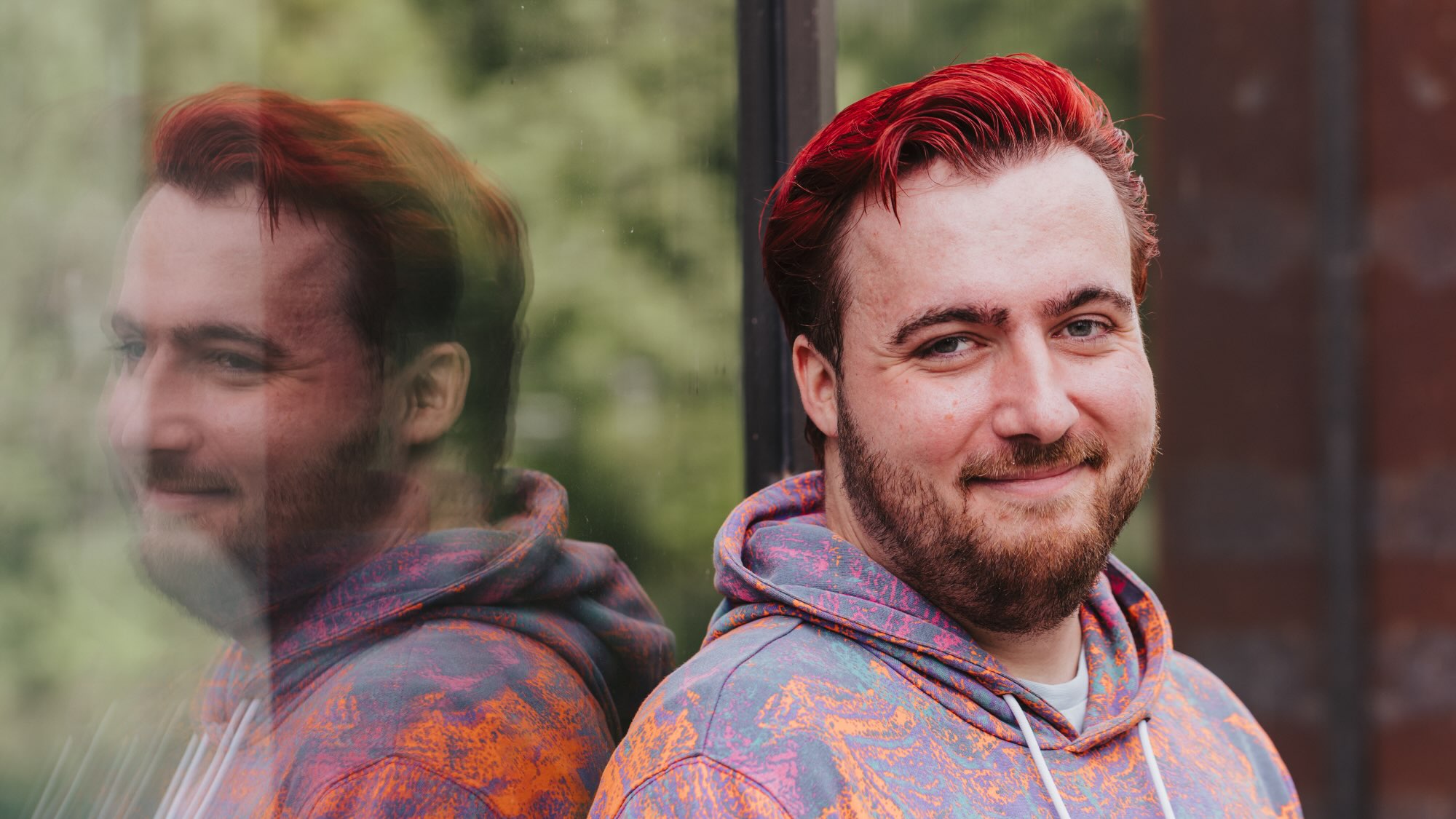
© Matej Meza / Universität Bremen
“Public Health Is More than a Field of Study to Me, It’s a Path to Change”
Peter Ambos on public health, research, and his journey from the lab to the University of Bremen
Peter Ambos is pursuing a master’s degree in Public Health – Health Services, Health Economics, and Health Management at the University of Bremen. He completed his bachelor’s degree here as well after having pursued an apprenticeship as a medical technical laboratory assistant (MTLA). He is now writing his master’s thesis, working at the SOCIUM research institute, and actively involved in politics. In this interview, he shares why public health fits his path, what he values about the University of Bremen, and what he’d like to see improved.
Peter, you didn’t start a degree right after school; instead, you first did an apprenticeship. What led you to pursue a degree later?
I never had the best grades, so an apprenticeship as a medical technical laboratory assistant (MTLA) was a good way to explore the healthcare sector and take a step toward studying medicine. But during my time at the clinic, I realized that being a doctor wasn’t for me. At the same time, I became deeply interested in politics, especially equity issues in healthcare. I wanted to understand how health works within society, and that led me to the field of public health. The University of Bremen was a perfect fit. A specialized Public Health bachelor’s program is rare, and Bremen offers exactly that, without needing to take a detour through administration or nursing.
What makes the program’s content and atmosphere unique?
The content is highly interdisciplinary. We study everything from medical foundations to healthcare communication, ethics, epidemiology, management, and economics. These aren’t niche topics; they offer a comprehensive view of the system. And we work together with real-world partners to develop practical interventions – study projects with measurable impact.
As far as the atmosphere, the groups are small, especially in the master’s program, and the lecturers are approachable. I’ve never felt hesitant about reaching out to them or stopping by their offices.
In addition to your degree, you work at SOCIUM, a social science research institute at the University of Bremen. How did that come about and what benefit does this have?
It was a fortunate coincidence. During the pandemic, I was one of the few with my camera on. A professor noticed me, and that led to my role as a student assistant. Since then, I’ve taken on various tasks: research for legal proposals, evaluations of care projects, and preparing Android tablets for field studies.
I really like the fact that I am taken seriously at this job. I’m part of the team, not just an assistant. And I’ve gained a much deeper understanding of how research works.
You’ve also been politically active at the university. What motivated you?
Politics have always fascinated me. I was a member of the SPD for a long time and active in “AStA für Alle” (AfA), including as a student council member, until 2023. Last year, I joined Die Linke. I wanted to help shape the university, even if it became frustrating over time. Still, university politics showed me how much creative freedom you can have if you invest the time.
Does being on campus feel like you’re a face in the crowd, or like you’re part of a community?
Definitely like part of a community. Bremen is small enough that you see each other often. And although I tend to be more introverted, I’ve never felt alone. Especially in Faculty 11: Human and Health Sciences, paths are short – both personally and professionally.
Do you feel seen at the University of Bremen?
Overall, yes. When I met with Academic Adjustments about my ADHD diagnosis, their reaction was straightforward, friendly, and pragmatic. That said, the university could make information more transparent and accessible by better organizing key resources on its website. Sometimes, you still need to use Google to find what you’re looking for.
You also have technical skills – what does programming mean to you as a hobby?
This is where I find balance. I can experiment and be creative, completely independently of theoretical work. I use Linux, build tools, and take computer science courses for fun, since I want to work on overlapping topics of digitalization and health. This field needs people who speak both the technical and the healthcare languages.
Public Health is a socially-oriented field. Are there topics that are especially important to you?
Access to healthcare, fair living conditions, and participation for everyone. The social dimension is central, yet often not fully considered. I’d love to see a university that doesn’t just research social issues, but lives by them – for example, in how it approaches semester fees or student housing. The university may have open ears, but sometimes, it reacts more than it shapes. There’s real potential here.
What would you say to beginning students, especially those without a straightforward educational path?
Get to know people early – in your program, outside of it, and in projects. That kind of connection may never be as easy again as it is at a university. And make a conscious effort to choose supervisors based on their research interests and their relevance to your thesis topics, and not just on name recognition.
In conclusion: Why should prospective students consider the University of Bremen?
Because here, you’re closer here to everything – to other disciplines, to people, to real-world applications. And you have more flexibility to carve your own path.
Come as you are
That’s not just a slogan at the University of Bremen; it’s actively encouraged. Feel free to reach out to our Student Advisory Service or explore all the opportunities the University of Bremen has to offer online.