
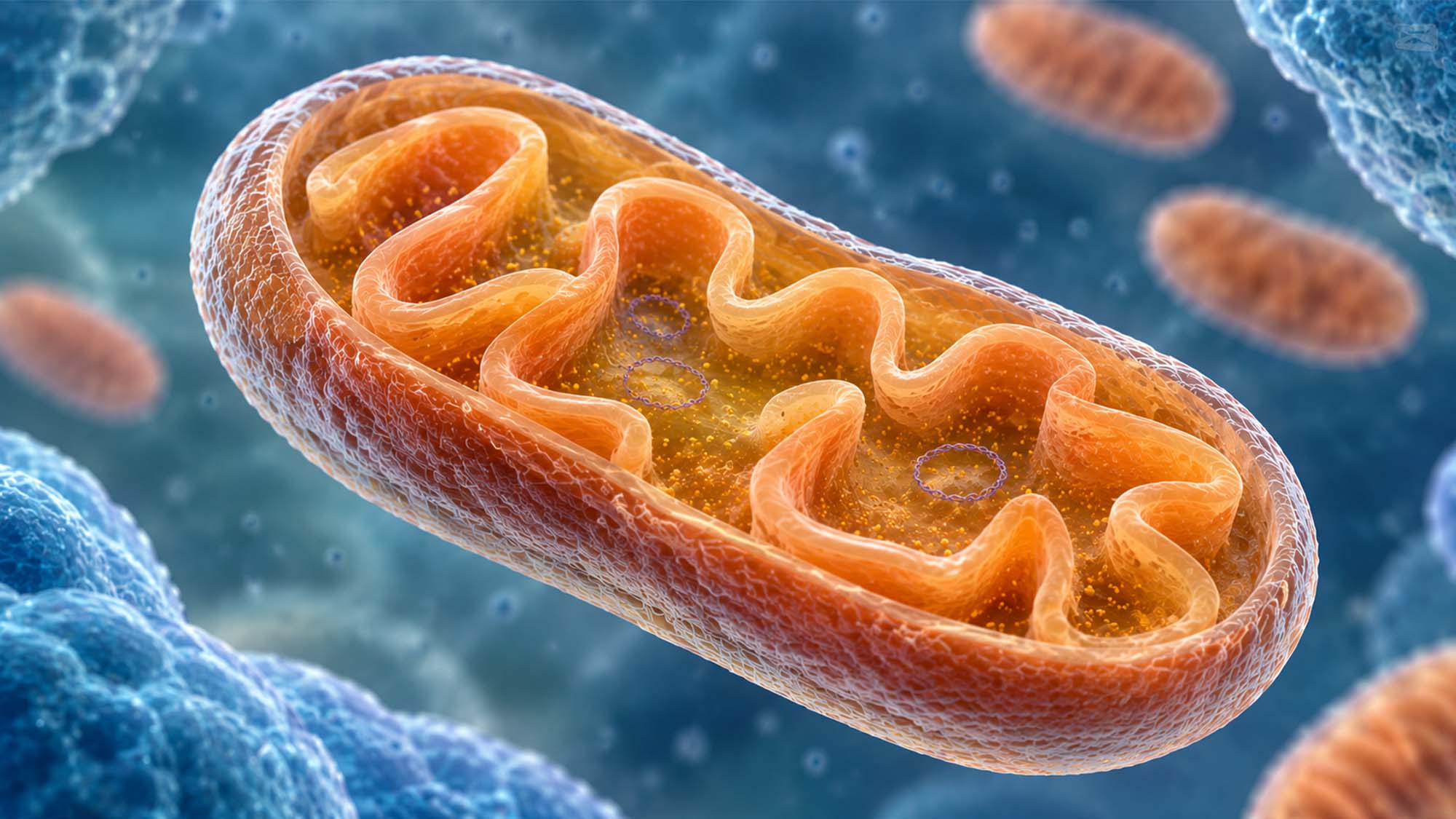
© OpenAI / AI-generated
Airport Operations in the Nerve Cell
Better knowledge of mitochondria can also can also help improve our understanding of many diseases. Professor Thomas Schwarz is convinced of this after his time as holder of a U Bremen Excellence Chair
Mitochondria are considered the powerhouses of the cell. If their function is impaired, this can contribute significantly to diseases such as Parkinson’s, dementia, ALS, or diabetes, says Professor Thomas Schwarz. As a holder of a U Bremen Excellence Chair, the neuroscientist investigated how the tiny cellular components interact, what affects their function, and how they move within the organism. This fundamental research lays the groundwork for new, promising therapeutic approaches.
The functions of mitochondria are diverse. They influence cell growth and development, support the immune system, store and distribute signaling molecules such as calcium, produce building blocks for other molecules, and generate reactive oxygen species that act as signaling molecules and help cells respond to changes in the organism. These complex roles raise questions about how mitochondria are controlled and moved by proteins, what happens when their function is disrupted, and whether all mitochondria perform the same range of tasks or have specialized functions within the cell. As a U Bremen Excellence Chair holder, Thomas Schwarz tackled these questions with researchers from Boston and Bremen. Excellence Chairs are awarded to outstanding researchers who serve as bridges between the University of Bremen and leading universities around the world. Thomas Schwarz is a leading neuroscientist based at Harvard Medical School and Boston Children’s Hospital. Due to his close ties with the University of Bremen, he will be appointed Research Ambassador in November 2026. Research Ambassadors are international researchers affiliated with the University of Bremen who connect continents, cultures, and academic disciplines.
Enriching Diversity of Perspectives
For seven years, from 2019 to 2025, with his Mitochondrial Dynamics project, he was a U Bremen Excellence Chair holder. His enthusiasm is palpable when he talks about this stage of his scientific career: “It was an exciting and stimulating time for me and an opportunity to interact with a community whose interests are more diverse than the strictly neuroscience-focused community of my Harvard department.” Dr. Rita Groß-Hardt, Professor of Molecular Genetics, was his host at the University of Bremen. “Dr. Rita Groß-Hardt is a true visionary and had assembled an extraordinarily broad group of scientists to think about mitochondria from different perspectives and different systems,” says Schwarz, citing a few examples: Dr. Mario Waespy looked at mitochondrial proteins from the perspective of a glycobiologist, someone who studies how sugars are added to proteins; Dr. Kathrin Maedler contributed her insights on the role of mitochondria in diabetes research and welcomed members of the research group into her lab. And Rita Groß-Hardt contributed her knowledge on plant mitochondria. Experts in molecular dynamics, biophysical engineering, and mathematical modeling also brought their expertise to the project: “I had never had an experience quite like it,” says Schwarz. “Just as it was broadening my understanding of the field, it also introduced a new focus on the diversity of mitochondrial types. That question had been on my mind, but we had never studied it.”
© Harald Rehling
How Do Mitochondria Divide the Work?
Through this work, the team identified several subgroups of mitochondria that take on different tasks. Rita Groß-Hardt and Kathrin Maedler compare this phenomenon to the division of labor on an airport tarmac, where different vehicles specialize either in transporting luggage, supplying passengers, or providing energy to aircraft.
The researchers focused in particular on the role of mitochondria in nerve cells: “Dysfunction of mitochondria has been implicated in many disorders, and many of them manifest as neurological symptoms including neurodegeneration,” says Schwarz. He attributes this connection largely to the special structure of neurons: “Neurons are unlike any other cell in the body. They have axons and dendrites that can extend long distances, up to one meter in humans. To keep these parts alive, they need to move proteins and organelles long distances,” says Schwarz. “It is no accident that neurons most prone to degeneration in ALS, Parkinson’s, Alzheimer’s, diabetes, and as a result of chemotherapy, are among the longest in the body.” In many of these cases, defects in mitochondrial movement are found and likely contribute to the decline of these neurons. “That is why understanding the proteins that move mitochondria and regulate their positioning is so important to us. Our efforts in Bremen were geared toward a better understanding of mechanisms that move and position mitochondria.”
Opportunity for New Treatment Methods
These insights could also help develop new therapies for people with neurodegenerative diseases. Understanding why mitochondria become dysfunctional and what downstream events drive their degeneration increases the chances of developing successful treatment methods for these diseases, says Schwarz. One promising approach could be to develop drugs that promote the movement and renewal of mitochondria. “Mitochondria do not last forever inside a cell. They need to be cleared away when bad and replaced with fresh ones. I sometimes compare it to the ventilation in a building: If the air is not changed, it grows stale,” says Schwarz.
He is sure the research results from his time in Bremen will keep him busy for a long time. In addition to the scientific momentum, this period also enriched him on a personal level. He formed many friendships during this time. “From my very first visit, it felt like I had joined a lovely family.” And his influence will continue to have an impact in Bremen – especially among the early-career researchers in his research group, who spent time working in his lab in Boston. “They returned with great enthusiasm and many new impressions,” report Kathrin Maedler and Rita Groß-Hardt. “Tom is not only an extraordinary scientist, but also a warm-hearted and dedicated host. His very presence in our department has strengthened the international visibility of our research and promoted both new and existing collaborations, within the University of Bremen, with the University of Münster, and with the renowned equipment manufacturer Bruker.” Bruker is now supporting them in analyzing the various subgroups of mitochondria in greater detail.
Diversity as a Fundamental Principle of Nature
For Rita Groß-Hardt and Kathrin Maedler, it remains astonishing “how this truly fascinating world of mitochondria is organized, how these small cellular organelles function and cooperate to create a greater whole.” This clearly demonstrates the importance of diversity and functional specialization for the performance of a system. “Nature shows us a principle that also applies to society,” the two scientists emphasize. “Diversity is a fundamental principle of nature, and diversity and communication are fundamental to high-performance systems – and vital to the success of the whole.”