
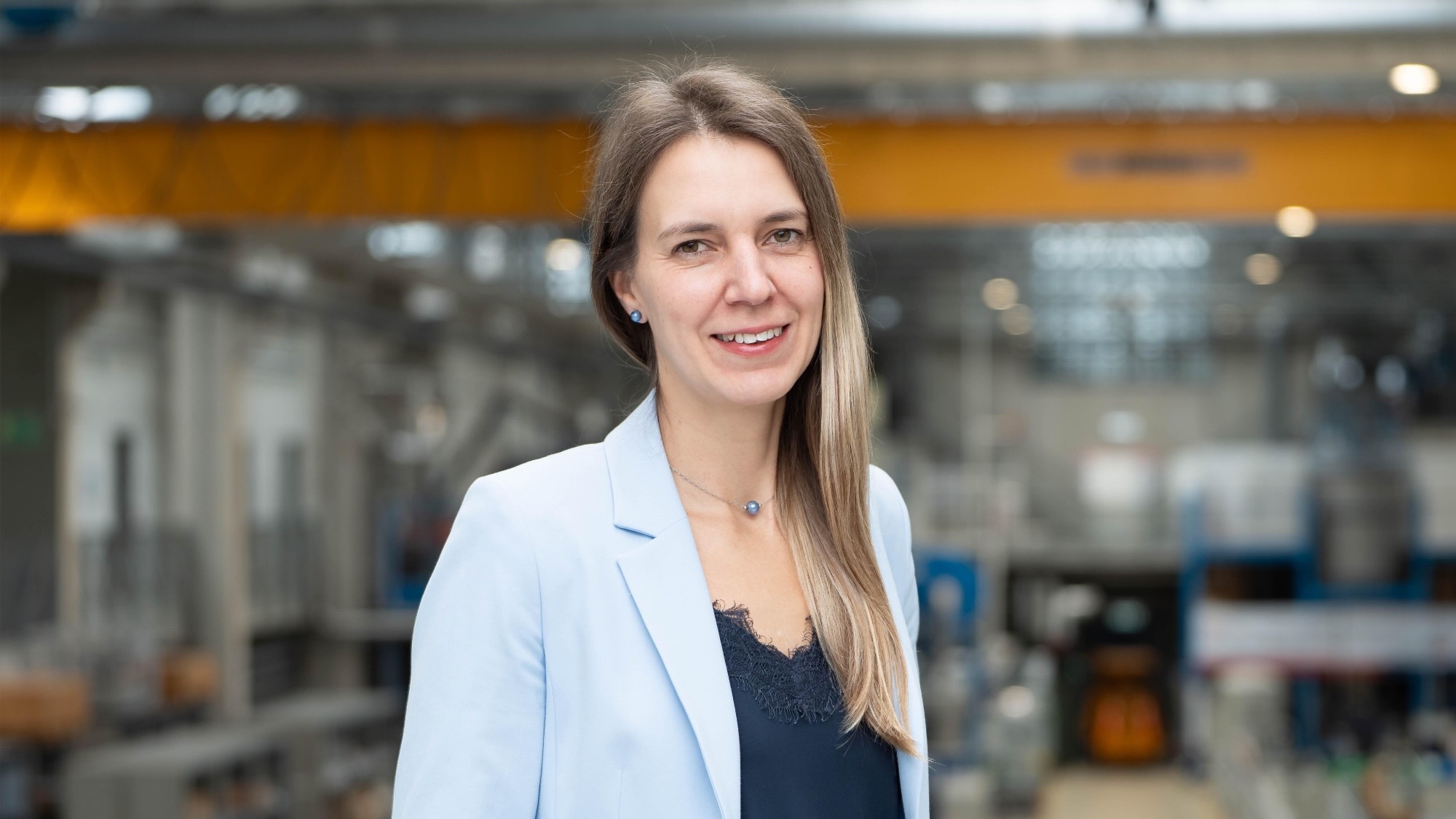
© Leona Hofmann / Universität Bremen
Atoms and Automotive Engineering
Evgeniya Kabliman wants to use nano-level simulations to accelerate materials development and conserve resources
During her education and research, Evgeniya Kabliman immersed herself in a wide variety of subjects, including mathematics, physics, materials science, production engineering, and machine learning. In her current role as director of the Leibniz Institute for Materials Engineering (IWT) and professor of knowledge-based digitalization in the materials-oriented production at the University of Bremen, this background is a huge advantage, since it allows her to bring many of these approaches together. Her current project has the goal of building an AI-controlled simulation framework that will enable materials to be developed faster and using fewer resources.
The project she is implementing as part of the Leibniz Programme for Women Professors is called “AI-guided Computational Materials Design for Sustainable Manufacturing and Materials Innovation,” or AIM for short. She will receive funding from the Lebniz Association for five years to cover the costs of both technical equipment and staff positions. Kabliman is collaborating with doctoral researcher Sachin Rangaswamy and postdoctoral researcher Dr. Mustafa Awd in the AIM project. What exactly are they working on?
Small Changes, Big Effects
“Our work in AIM is both very tangible and yet invisible to the naked eye,” says Evgeniya Kabliman. The starting point is additive manufacturing of materials, a type of 3D printing in which metals are layered on top of each other. This process can be applied directly to automotive and aerospace engineering to develop complex components for support structures, mountings, heat sinks, and aircraft engines. Optimizing the materials for greater robustness and durability is a complex process that requires an understanding of the materials at the atomic level. This project combines materials science and production engineering to achieve this goal.
“In materials research, we distinguish between three different levels of materials: macro, micro, and nano,” explains Kabliman. “The macro level includes everything that is visible to the naked eye. Zooming in further brings us to the micro level, which can be seen under a microscope. Below that is only the nano level, where structures can be examined at the atomic level.” However, understanding how changes at one level affect the others is a central challenge in materials science. This is because tiny changes at the nanoscale, such as in the arrangement of atoms or electron density, can have significant effects at the microscale and macroscale. This is precisely what makes materials development so complex and costly. To optimize materials, metals such as steel, aluminum, and nickel alloys are combined at different temperatures, for different time periods, and under different pressure conditions. The strength, porosity, and elasticity of a material can only be determined after the experiment is finished.
More Simulations, Fewer Experiments
This process requires a lot of time and resources, and Kabliman wants to change that. She is developing a framework consisting of various computer programs that will digitally map and simulate these experiments. This framework will enable testing the properties of any number of alloys made from different metals while taking production conditions such as temperature, pressure, and time into account. The simulations will make it possible to switch between different levels. “For example, you could specify certain arrangements of atoms and then assess the strength of the finished material,” Kabliman explains. “Or, you could investigate how the atomic structure of metals changes when mixed at specific temperatures and pressures.”
“While experiments are not completely unnecessary, their number can be significantly reduced.”
The simulation framework combines existing expertise from publications and materials databases, modeling methods on different length scales, and AI that calculates the effects of changes in one level on the others. The most promising results can then be verified in experiments. “While experiments are not completely unnecessary, their number can be significantly reduced,” says Kabliman. The areas of application are vast. Kabliman’s research is significant not only in aerospace and automotive engineering, but also other fields such as medical technology for developing implants or surgical tools.
Research and Teaching — The Best of Both Worlds
Evgeniya Kabliman also wants to show her students that her research has practical applications. Teaching is close to her heart, which is one of the reasons she came to Bremen. Throughout her career, she has worked at universities and non-university research institutes, and she was looking for a place where she could combine research and teaching. “The cooperation professorship at the University of Bremen and the IWT is therefore ideal,” she says. This is especially true because her field of expertise, computer-aided materials science, is so specialized that there are hardly any degree programs in Germany that cover it. She not only presents her research in theoretical courses but also plans to involve students practically at the IWT, for example, with applicable bachelor’s or master’s theses topics. For Kabliman, sustainable innovation begins not only in the laboratory – but also in the lecture hall.