
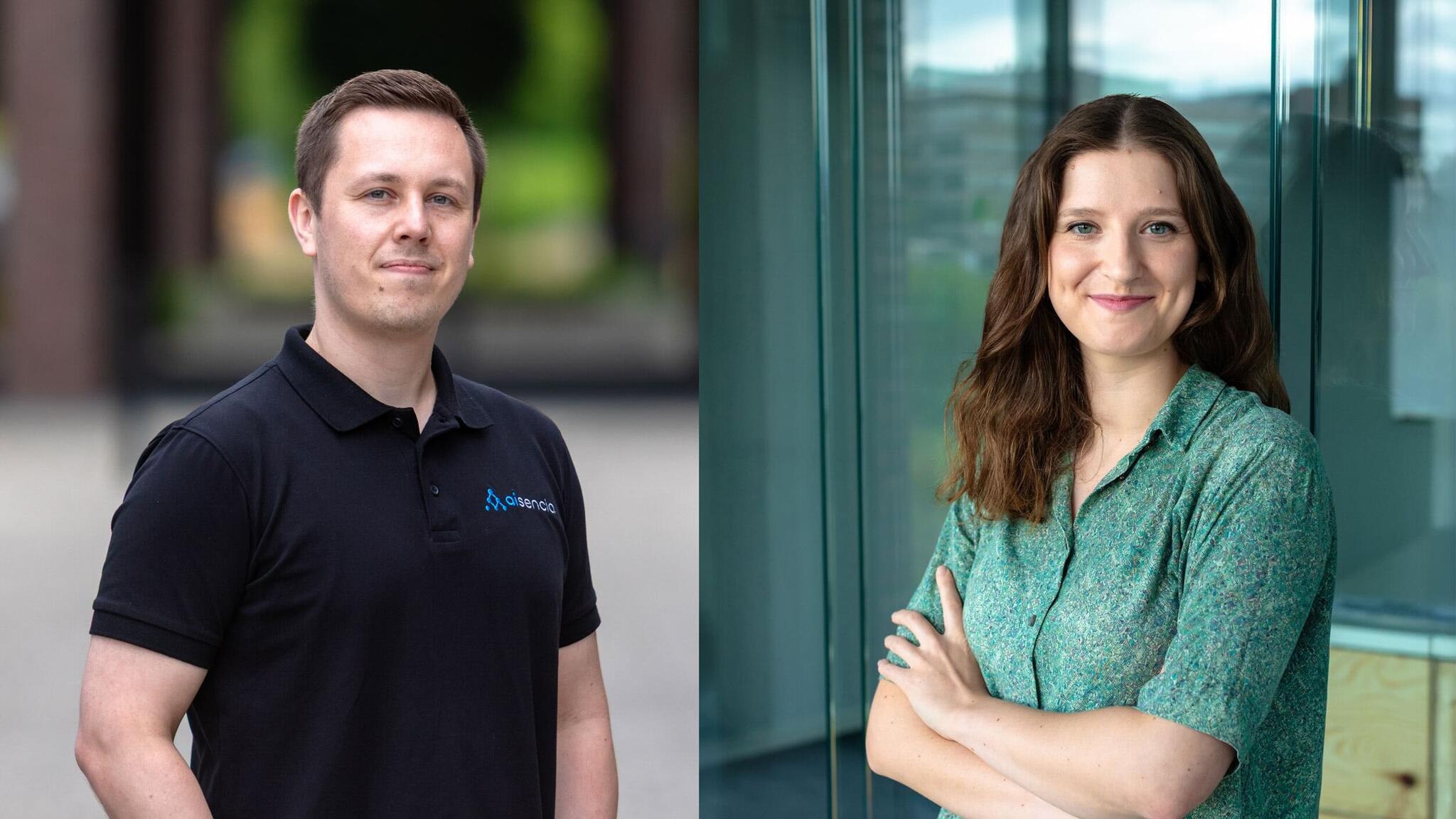
© Universität Bremen / Matej Meza
Leaping Into the Unknown
Kristin Blesch and Maximilian Schmidt took the leap from the world of research to starting their own business – a move that transformed not only their way of working but also their sense of identity
Launching a start-up from within the academic world brings many changes. Suddenly, you’re not just a researcher, you’re also an entrepreneur. How does it affect people when they shift their focus from advancing knowledge to meeting the demands of the market? Kristin Blesch and Maximilian Schmidt spoke with us about their experiences.
A New Way of Working
aisencia founder Maximilian Schmidt describes the transition from academia to the start-up world as a “challenging but rewarding process.” As a member of the Industrial Mathematics research group at the University of Bremen, he spent many years working on theoretical questions. However, a stroke of inspiration from a pathologist led him to recognize the potential to revolutionize the analysis of skin samples using artificial intelligence.
The opportunity to translate his research directly into a medical application led him to found aisencia. Together with Jean Le’Clerc Arrastia, Daniel Otero Baguer, and Dietrich Schreiber, Schmidt developed an AI-powered diagnostic tool capable of detecting over 40 skin conditions, which is currently undergoing certification for the European market.
When Schmidt founded the company, not only did his field of work change, but also his way of working. “Many things related to administration happen much faster when you’re starting a business than they do at a university. I had to get used to that at first.” Instead of focusing solely on research, he now spends his days on management, administrative tasks, and business decisions, including bookkeeping, regulatory matters, and meetings with investors.
The shift in roles became particularly clear when they hired their first employee outside the founding team in late 2023. Assuming the role of CEO also marked a milestone: “Suddenly, you find yourself carrying responsibility – not just for projects, but for people and the future of the company.”
“Suddenly, you find yourself carrying responsibility – not just for projects, but for people and the future of the company.” Maximilian Schmidt
Nevertheless, his scientific background continues to help him to this day, for example, with structured problem-solving or writing applications for funding. The team received support from the University of Bremen’s start-up support services, particularly when applying for the EXIST program and throughout the entire start-up process.
A New Sense of Identity
Kristin Blesch aims to bridge the gap between academia and industry, making AI applications transparent and trustworthy. While pursuing her Ph.D. at the Leibniz Institute for Prevention Research and Epidemiology (BIPS) and the University of Bremen, the computer scientist conducted research into a contemporary issue: Many AI algorithms are a black box to users.
But especially when it comes to businesses, transparency is key to building trust in AI applications. “The available software is geared more toward an academic audience and doesn’t really focus on practical applications,” says Blesch. “There’s a lack of user-friendly solutions with user interfaces for direct use in a business context.”
She now plans to develop this technology together with two co-founders, with support from the EXIST program by the Federal Ministry for Economic Affairs and Energy, as well as the BRIDGE university start-up network at the University of Bremen.
The leap to starting a business has not only transformed her way of working, but also her sense of identity. “Suddenly, issues like business financing, marketing, and customer interactions come into play,” says Blesch. The academic perspective is no longer enough – now we also need to compete in the market.
“BRIDGE and the EXIST program make starting a business easier.” Kristin Blesch
She has received invaluable support from BRIDGE and the Bremen start-up community. “Everyone is very open-minded and interested in a wide variety of topics,” says Blesch. Through BRIDGE’s networking events, counseling services, and other programs – like the pitch training offered as part of the StartUp Workout – she learned how to translate academic research into viable business models early on. Above all, Kristin Blesch wants to leave a positive impact on the economy and on society.
University of Bremen’s Transfer Magazine
This article first appeared in the 2025 Transfer Magazine by UniTransfer – the University of Bremen’s service point for knowledge and technology transfer. The magazine highlights individuals, projects, and collaborations that demonstrate the global social impact of Bremen’s research, extending well beyond our region.
Download the Transfer Magazine (in German) as a PDF [6,6 MB]