

© Leona Hofmann / Universität Bremen
Pure High-Tech
Flexible and portable biosensors are one of the applications being researched in the cleanroom of the Institute for Microsensors, -actuators, and -systems (IMSAS)
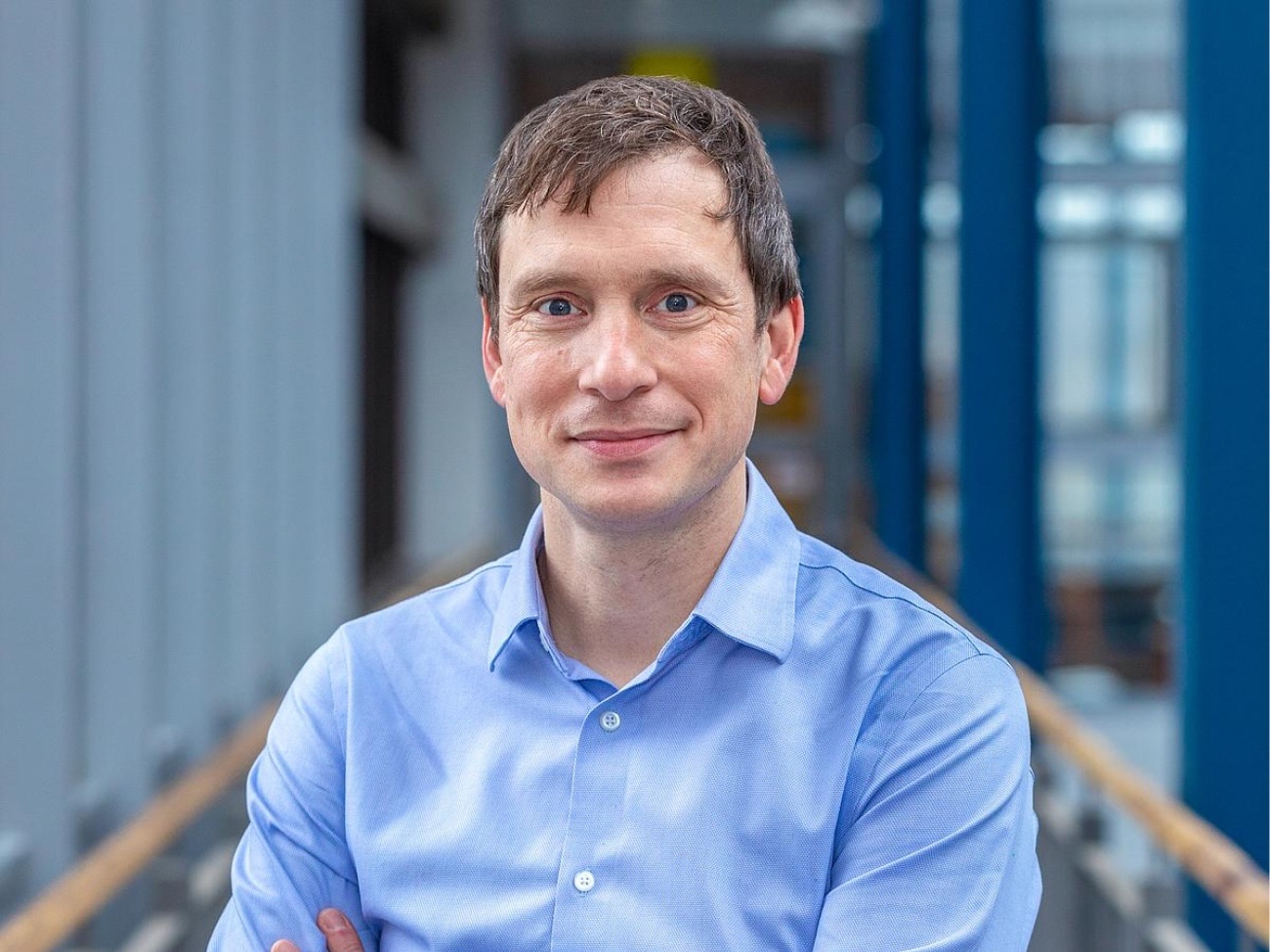
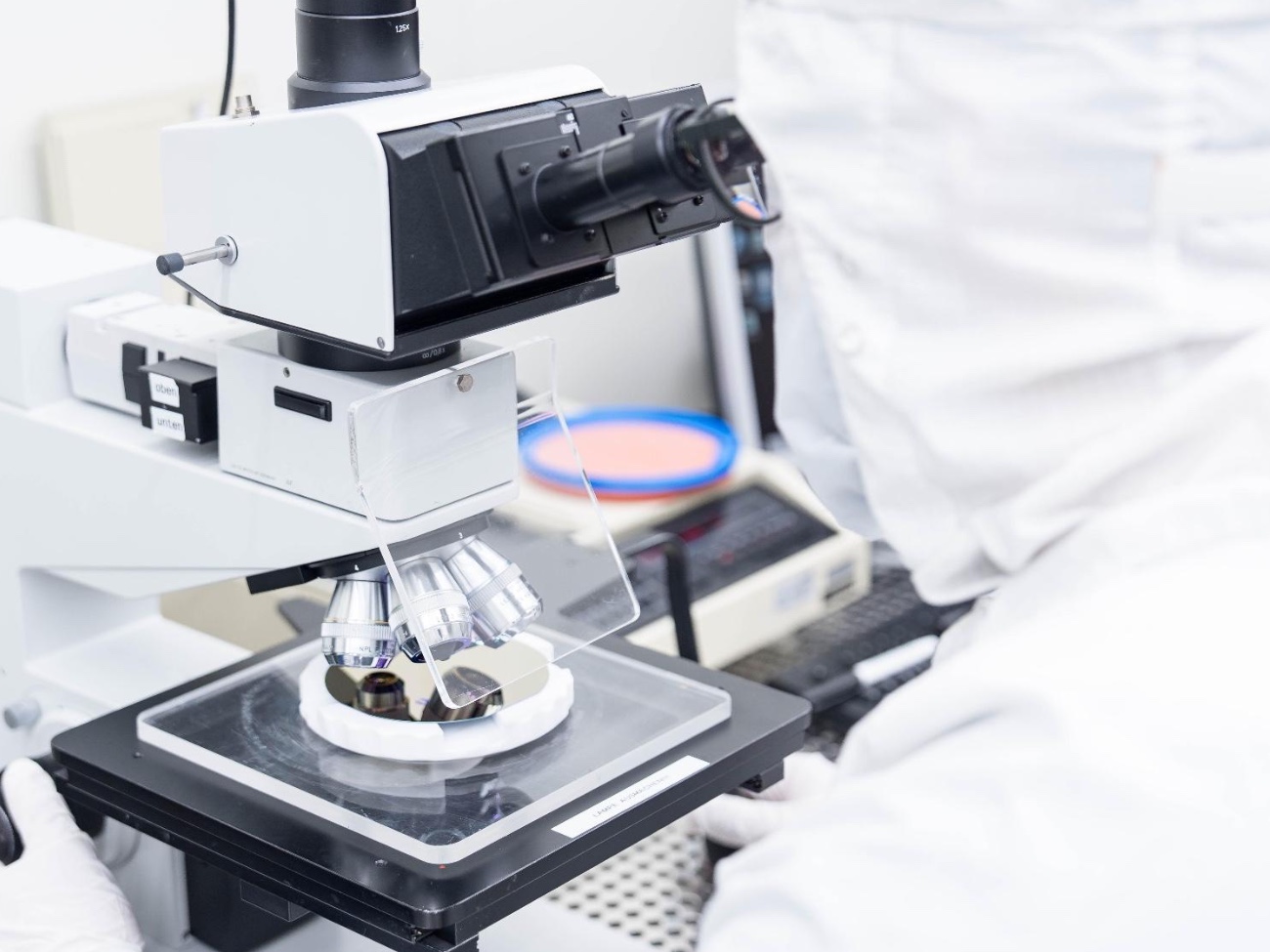
Central to research in the Institute for Microsensors, -actuators, and -systems (IMSAS) is a 900 square meter cleanroom that provides a controlled environment by maintaining consistent temperature, humidity, and moderate pressure levels, while keeping dust, bacteria, and particles at bay. “What the University of Bremen provides here is quite exceptional,” says Professor Björn Lüssem.
Preparing to enter the cleanroom requires a significant amount of time and effort. Researchers must put on a cleanroom gown and hat, change shoes, and put on gloves and safety goggles. Even for seasoned researchers like Björn Lüssem, this process takes at least five minutes. Those with less experience require much longer to suit up. Everyone who researches here must also first undergo extensive preparatory training that includes how to properly handle chemicals and equipment, general safety instructions, which protective gear is needed, and how to put this on. After all, the goal is to make complex processes reproducible, and even the smallest impurity can render highly sensitive microchips, sensors, or circuit boards unusable.
In the cleanroom, which is located in a two-story annex of the NW1 building on Otto-Hahn-Allee, professors Björn Lüssem and Michiel Vellekop and their research groups are developing new flexible sensors with organic semiconductors made from carbon-based compounds. These are used, for example, as organic light-emitting diodes (OLEDs) in televisions. In contrast to silicon, these are soft, stretchy, and water-resistant, making them ideal for new, wearable applications.
© Matej Meza / Universität Bremen
Small, Flexible, Life-saving
One research approach is to develop sensors that can detect biomarkers associated with perspiration to determine how stressed a person is. Another approach is to measure blood sugar or insulin with small chips. “The goal is to develop sensors that increase quality of life and potentially extend lifespan. They are so small and flexible that you don’t even notice them,” explains Lüssem. But the institute’s research is not exclusively related to health applications. Researchers are also working on a joint project to develop hydrogen sensors that can monitor pipelines or tanks.
“For the local research and business community, the cleanroom is an enormous resource”
The research groups of Lüssem and Vellekop are also conducting foundational research. Parts of the cleanroom are rented out to startups and companies, such as microfab Service GbmH, a spin-off of IMSAS. The company manufactures microsystems for the global market, and additional spin-offs use the infrastructure as well. “For the local research and business community, the cleanroom is an enormous resource,” says Lüssem. “This multipurpose use puts us in a special position in Germany. Here, startups and companies have the opportunity to develop high technology without having to first make significant investments in equipment.”
© Leona Hofmann / Universität Bremen
Ready for New Tasks
The cleanroom is currently undergoing extensive renovation using funding provided by Bremen State and the university. The safety technology will be repaired, along with the ventilation, lighting, and power supply, which will further reduce energy consumption. In addition to researchers and company employees, students can also use the cleanroom under supervision. The further along they are in their degrees, the more independently the students are allowed to work there. With around 30 employees, IMSAS is involved in electrical engineering courses, including two held in English that attract international students to Bremen.
Lüssem came to Bremen in 2021, after working as an electrical engineer for a long time in the U.S. in Ohio. “My previous university cannot compete with the opportunities afforded here,” he says. “We can scale and perform processes on several hundred sensors simultaneously under controlled and constant conditions, which results in a correspondingly high yield.”
Further Information:
About the Institute for Microsensors, -actuators, and -systems (IMSAS)
About Degree Programs
Electrical Engineering and Information Technology (B.Sc. / M.Sc.)
Systems Engineering (B.Sc./M.Sc.)
Control, Microsystems, Microelectronics (M.Sc.)