

© privat
Studying Abroad with YUFE
Kübra, Rena, and Jaro are active members of the YUFE European university alliance and tell us what it has to offer students
Do you want to learn new languages, sit in seminars with students from all over Europe, or spend a semester abroad? The YUFE (Young Universities for the Future of Europe) university alliance offers all of this. Rena Gertje, Kübra Yeşilova, and Jaro Pleus explain exactly what YUFE is all about. They represent the University of Bremen in YUFE’s Student Forum and tell us about the opportunities offered by YUFE and their own experiences.
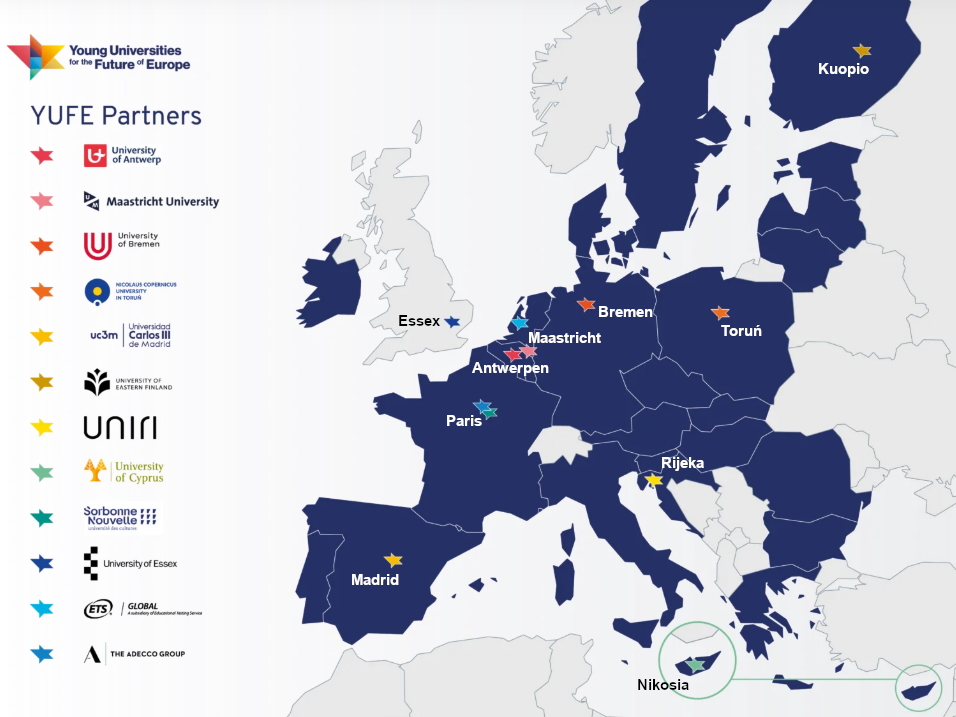
The concept behind YUFE is: Ten universities from ten countries form a joint university. What does that mean specifically for students in Bremen?
Jaro: Anyone studying at one of the participating universities can also take advantage of offerings from the others. This could include, for example, language courses, classes in various subjects, opportunities for volunteer work, or entrepreneurship programs where you develop business ideas together with other students. Some of the programs are virtual, some are in-person, and some combine both. This way, everyone can gain international experience, whether it’s from their own room or during a semester abroad.
Rena: It’s also good to know that the opportunities are free for students. And if you want to spend a semester abroad with YUFE, you can study at one of the partner universities through a YUFE Minors. The YUFE Minors are 30-credit-point programs linked to various topics, such as sustainability, innovation, and inclusion.
© YUFE-Alliance
What are your responsibilities as student representatives?
Rena: YUFE is all about the involved universities networking – and this doesn’t just mean researchers and staff from technical and administrative fields, but students as well. The YUFE Student Forum consists of three students from each university. We represent the students’ perspective within YUFE and meet online once a month and in person twice a year at the respective universities. We also contribute to the various areas of the alliance. I am the Student Forum’s vice president and work in the area of engagement. This involves thinking about how YUFE students can network better and how even more students can find out about YUFE. For example, we’ve introduced a virtual café where people can get to know each other better.
Kübra: That’s also an important topic in the Communication Task Force, of which I’m a member. I’m also active in BioYUFE – an association of researchers from the YUFE universities in the fields of biology and the life sciences. They also offer courses for students, and I bring the student perspective to the planning process. I’m studying biology myself, so I can easily combine this with my degree.
Jaro: I work in the area of entrepreneurship. YUFE has several initiatives, such as the YUFE Challenge Teams, where students can collaborate to develop entrepreneurial ideas. We’re currently working on expanding our connections with local companies and other organizations.
What motivated you to get involved with YUFE alongside your degree?
Kübra: I especially love the interaction with other students. At our meetings, I gain so many new insights into other countries and universities, through contact with students from all over Europe and a wide variety of disciplines. It’s also great that physical meetings aren’t strictly necessary – as demonstrated by our new Virtual Café format, where you can easily connect with other YUFE students digitally.
Rena: I strongly support the values that YUFE stands for – that education should be inclusive and open to as many people as possible, and that universities should be closely connected to their local communities, for example through programs for lifelong learning or social engagement.
Jaro: The universities in the YUFE Alliance are all relatively young. I think you can feel that in the collaboration. These are institutions that are open to change, where you can make a difference.
What specific steps do you need to take if you’re a student who wants to take advantage of what YUFE has to offer?
Rena: All students enrolled at one of the partner universities who have a good command of English can take advantage of YUFE’s offerings. It doesn’t depend on your grades or previous international experience. For the YUFE Virtual Campus, you can simply register with a certificate of enrollment and proof of English proficiency, such as your high school diploma. Then you just need to take a few onboarding courses on topics like equity, diversity, and inclusivity, as well as the YUFE Code of Conduct. After that, you’ll be officially accepted and can start taking advantage of all the programs. There’s also an official virtual welcome event.
Kübra: By the way, you can also get credit points for many things, such as courses or language classes, toward your own degree program. For this, it makes sense to speak with the respective program coordinators.