© Leona Hofmann / Universität Bremen
Giving War a Human Face
Ukrainian student Yuliia Kotvytska talks about her experience with the war in Ukraine – and what she hopes to accomplish with the “Unissued Diplomas” exhibit
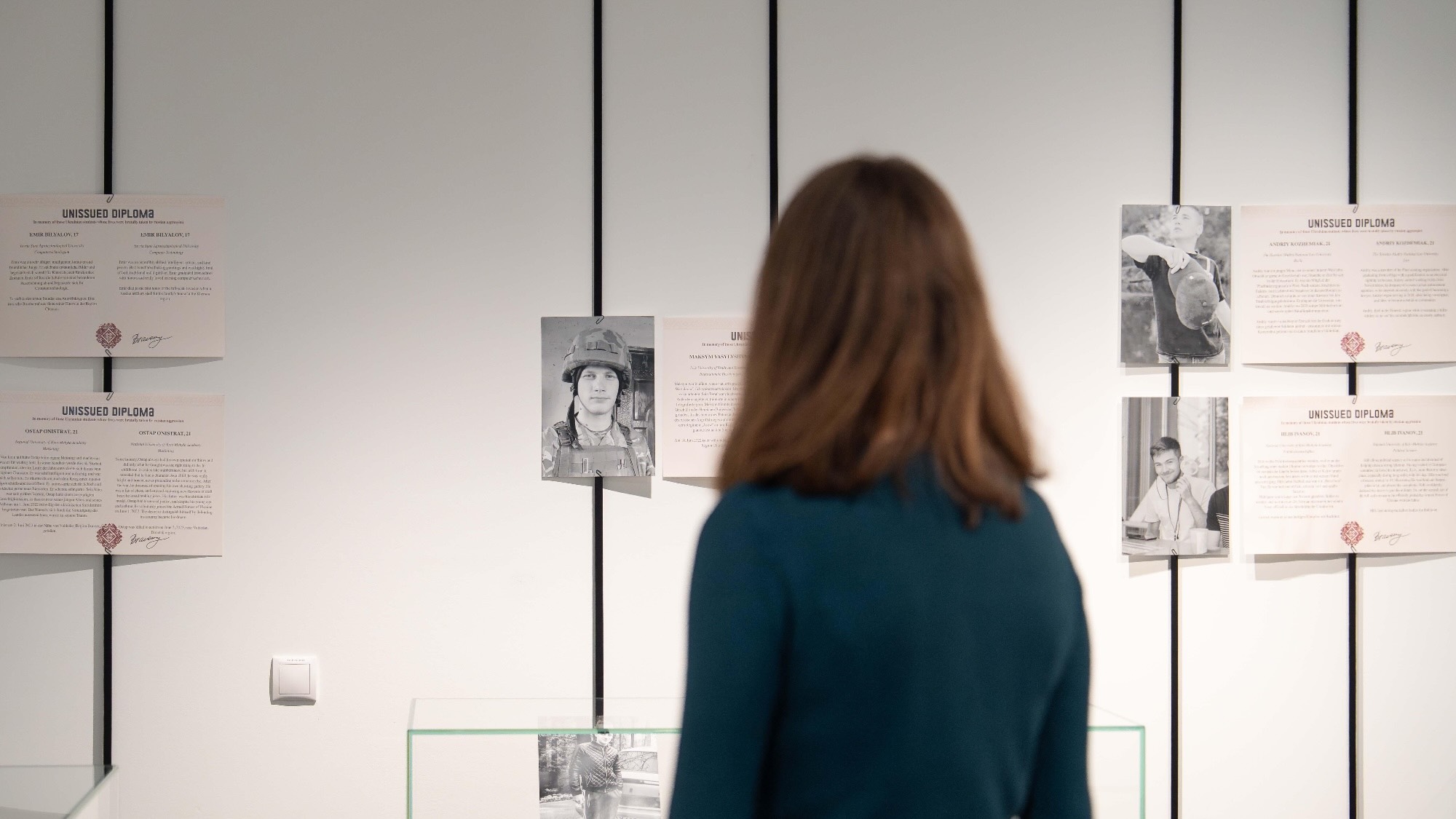
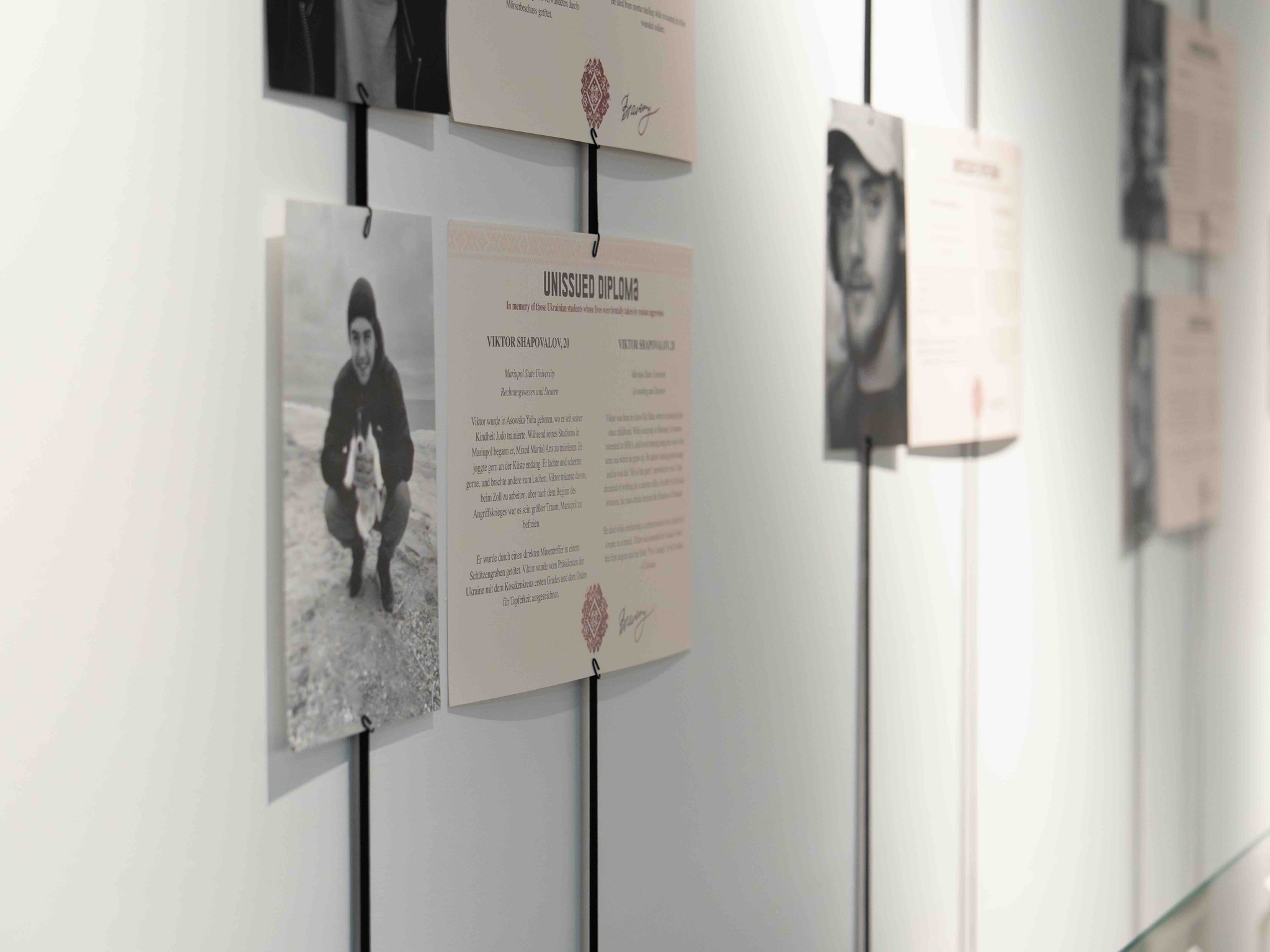
The “Unissued Diplomas” exhibit at the State and University Library Bremen has displayed the life stories of 40 Ukrainian students since mid-February. These students have one thing in common: They were killed in Russia’s war of aggression, either as civilians in Russian attacks, or as soldiers on the frontlines. One of them was a university friend of Yuliia Kotvytska. Kotvytska is a 23-year-old German Academic Exchange Service (DAAD) scholarship recipient who is pursuing a master’s degree in International Relations at the University of Bremen. She discusses how the exhibit was created and her journey from Kyiv to Toronto to Gießen to Bremen.
Yuliia, how did the “Unissued Diplomas” exhibit come about?
I spent a few months at the University of Toronto during the 2022/23 winter semester, alongside more than a hundred Ukrainian exchange students. Even though – or perhaps precisely because – we were so far away from home, we wanted to raise awareness about the situation in Ukraine, so we set up information and campaign stands. After the semester ended, our group scattered. Some stayed in Toronto, while others moved to the United States, Europe, and other parts of the world. Despite the geographical distance, we looked for a project we could work on together. That’s how we came up with the idea for the “Unissued Diplomas” exhibit. The goal of this exhibit is to raise awareness of the war and give a human face to the enormous number of casualties. We presented the exhibit for the first time on the anniversary of the Russian invasion in February 2023.
A lot of time has passed since 2023. Why is the exhibit still being shown?
In the beginning, we asked students if they wanted to host the exhibit at their own university. As time progressed, more and more students approached us and asked if they could host it as well. This continued throughout 2023 and in the years since. To date, the exhibit has been shown more than 300 times in over 30 countries.
What do you think is the reason for its great success?
We intentionally designed the exhibit to be easily displayed in many places worldwide. We put together a special toolkit with printable documents and additional setup information. At some point, things snowballed in the best way possible and more and more people approached us about presenting the exhibit. That was very exciting!
What does your work with the exhibit mean to you personally?
That is a tricky question. On the one hand, preparing the exhibit was quite emotionally taxing. When we started the project, most of us were in our early twenties. At that age, many people are politically and socially involved. However, that’s a very different experience than talking to people about friends of yours who died in war. I knew one of the students featured in the exhibit quite well. Even though I have worked on this exhibit for many years, it doesn’t get any easier. Before a new exhibit begins, like here in Bremen now, I read through all the text. Each time, the sorrow overwhelms me anew.
On the other hand, the project gives me a sense of purpose. It was also a kind of therapeutic experience that helped us cope with the death of our friends. Our exhibit raises awareness that the war is ongoing and still claiming lives. For me, sorrow and a sense of purpose coexist.
© Leona Hofmann / Universität Bremen
What was your personal experience with the war?
I remember getting together with friends in Kyiv at the end of January 2022. One of them said, “Who knows? Maybe this will be the last time we’ll all be together.” Those words proved to be prophetic.
In the fall of 2021, I made plans to study abroad in Gießen for the summer semester of 2022 with the Erasmus program. When the war erupted, I hesitated about whether to actually go. The typical Erasmus experience, with its excursions and parties, suddenly felt wrong. However, my parents encouraged me to go, and I would be safe in Gießen.
Nevertheless, the war played a significant role in my daily life. I helped Ukrainian refugees find apartments and settle in Germany. For many years, working on the “Unissued Diplomas” exhibit has been a central aspect of my life.
The war has been going on for four years now. How does this affect you?
The war accompanies me every day. It has become a ritual for me to contact my parents every morning after I wake up and ask them how they are doing. I also talk about it with my friends here at the university.
It is a constant burden. At the same time, I have noticed that others from Ukraine, myself included, have found ways to cope with it, often using humor. When I return to Ukraine, I am in awe of its people’s strength. I have the feeling that nothing can break them.
Further information
You can visit the “Unissued Diplomas” exhibit at the State and University Library at the University of Bremen campus.