
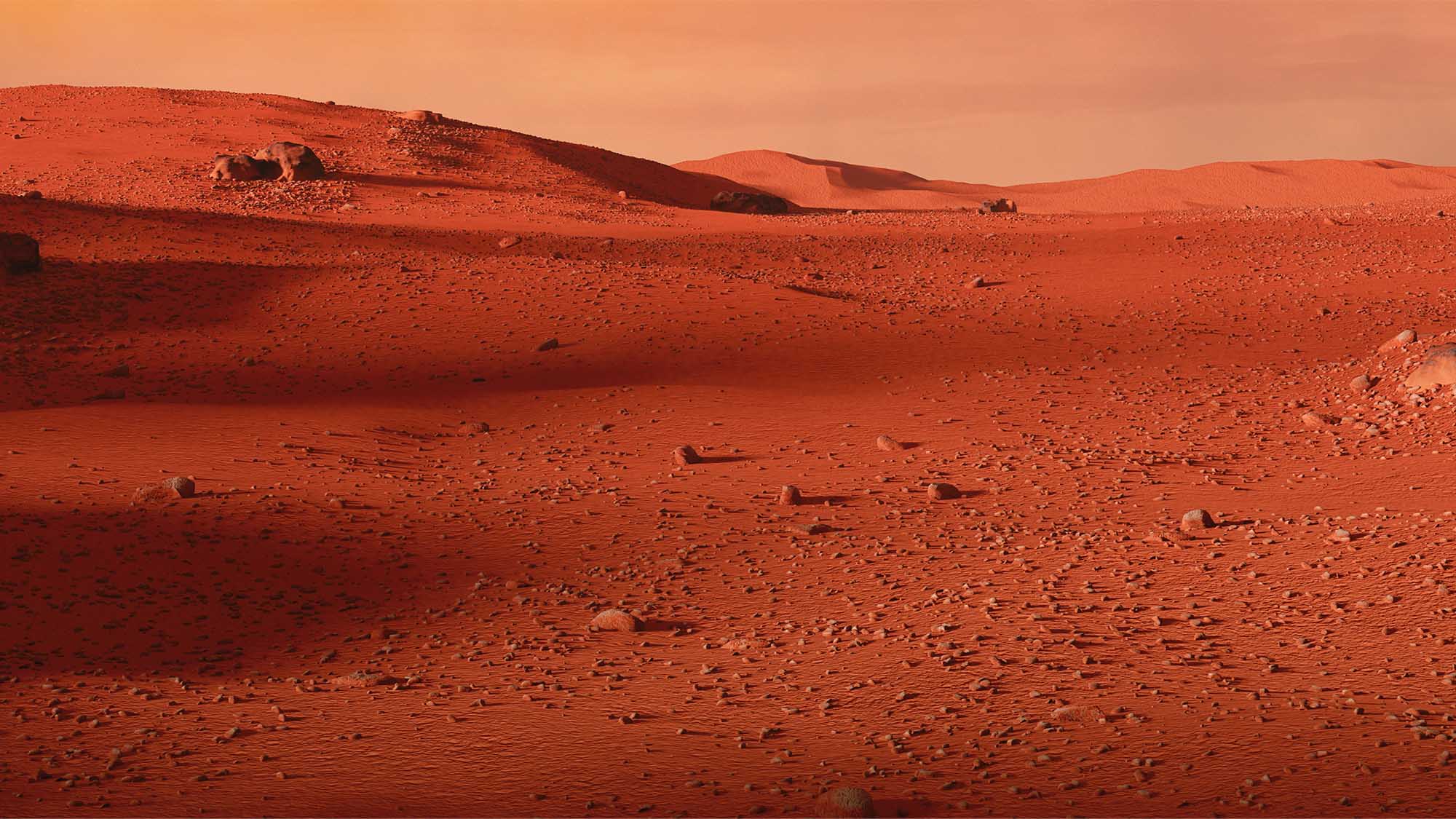
© dottedyeti / Adobe Stock
Learning from Microbes for Mars Missions
Insights about microorganisms can be extremely useful in space, says astrobiologist and U Bremen Excellence Chair holder Charles Cockell.
Microbes are among the most adaptable life forms on Earth. These mostly single-celled organisms can survive in the most diverse environments; some species do not even need oxygen. Within The Martian Mindset Cluster of Excellence, Professor Charles Cockell, holder of a U Bremen Excellence Chair, is investigating how microbes can help sustain human life and might help solve critical material shortages in extraterrestrial environments such as Mars.
“The Excellence Chair provides me with a unique opportunity to work with engineers and scientists at one of Europe’s leading universities,” says Cockell. With his expertise, the British astrobiologist has been supporting the new Cluster of Excellence, The Martian Mindset, since early 2026, which is funded by the German Research Foundation (DFG).
The cluster brings together researchers from multiple faculties at the University of Bremen, along with partners from other Bremen institutions and international research centers. “Here, we have the opportunity to apply our joint scientific knowledge to the future human settlement in space,” says Cockell, who is joining the team as a U Bremen Excellence Chair. These are awarded to outstanding researchers who serve as bridges between the University of Bremen and leading universities around the world.
Astrobiology as an Interdisciplinary Natural Science
Cockell, who researches and teaches at the University of Edinburgh, is one of the world’s leading experts in astrobiology, a field that combines astronomy, biology, chemistry, and geology to explore the origins, evolution, and potential for life in space. At the University of Bremen, Cockell is hosted by Professor Cyprien Verseux, head of the Laboratory of Applied Space Microbiology at the [Center of Applied Space Technology and Microgravity (ZARM)](https://www.zarm.uni-bremen.de/en/. Verseux is pleased about the collaboration and Cockell’s wealth of experience: “He has led pioneering projects on Mars research and exploration, from local governance and resource utilization to biotechnological applications, and his creativity, insight, and collaborative spirit make him an exceptional partner.”
Enhancing Human Success in Extraterrestrial Environments
Within the Cluster of Excellence, Cockell focuses on microorganisms in particular. He has already developed innovative strategies to extract valuable elements from Martian regolith using microorganisms. “Microbes have been cycling and transforming elements on the surface of the Earth for billions of years,” he explains. “How can we harness this natural capability to enhance human success in extraterrestrial environments? I think this is a fascinating and interesting scientific question that will ultimately help us understand how to use microorganisms here on Earth to accomplish environmentally and industrially useful tasks.”
This approach lies at the heart of the cluster’s mission. Though Mars is around 225 million kilometers away, many of the challenges that an expedition or even a settlement of the red planet would present are increasingly relevant for life on Earth – particularly the limited natural resources. The cluster’s name, The Martian Mindset, is quite literal as it invites researchers to imagine a potentially habitable but inhospitable world with a thin CO2 atmosphere and no fossil fuels or extensive water resources. The researchers use this scenario of scarcity in order to find solutions that would not only work on Mars but also enable a more sustainable use of resources on Earth.
The cluster brings together around 100 researchers from diverse fields, including engineering, materials science, robotics, communications technology, psychology, and, of course, astrobiology. “The most challenging part of this research is taking what we know on Earth and applying it in a very alien environment – the environment of Mars,” says Cockell. “That demands bold thinking and unconventional problem-solving approaches.”