

© Leona Hofmann / Universität
Multilingualism and Mopan Maya: A Study of Language Contact and Its Implications
Linguist Nicole Hober is researching a sub-form of the Mayan language in Belize and assisting with a translation of The Little Prince
When recording conversations in Mopan Maya in southern Belize, Nicole Hober focuses on how multilingualism influences everyday life and how speakers rate the contact between the Mopan language, English, and Kriol (Belizean Creole). Her research goes beyond language use and code-switching to address prevalent concerns about the indigenous language losing its autonomy due to outside influences. Hober’s research also highlights the interconnectedness of language usage, history, and colonial legacies.
Nicole Hober, a doctoral researcher at the University of Bremen, is investigating the influence of English on Mopan Maya. This indigenous language is part of the Mayan language family and is spoken by about 11,000 people in Belize as well as 3,000 in Guatemala. Hober’s chosen research location is particularly interesting because “Belize is the only English-speaking country in Central America where Mayan languages are spoken.” In Central America, Spanish is usually the dominant contact language, but in Belize it is English (and, to a lesser degree, Belizean Creole) that is influencing the indigenous languages.
Language Usage
Nicole Hober’s research methodology follows a holistic approach. She makes audio recordings of various conversational situations and analyzes them, often in collaboration with native speakers. These recordings reveal the systematic switching between Mopan, English, and Kriol, depending on conversation partners, topics, and situations. In linguistics, this type of situational switching is referred to as code-switching.
Stanley Peck, a Mopan speaker and language activist, exemplifies this code-switching. When speaking with his peers, the 29-year-old mostly speaks a mix of Mopan Maya, Kriol, and English. With older people, in contrast, he speaks significantly more Mopan – often subconsciously. “Such patterns follow clear communicative rules,” says Nicole Huber. “They show how multilingualism is organized in daily life.”
“Code-switching is a strength.”
At the same time, many speakers emphasize that they want to use as little English as possible, especially in writing. “The collective analysis often leads to amazement at how much more often English terms are used,” says Hober. However, Hober views this as an indication of linguistic competence rather than language decay. “Code-switching is a strength. The key point is that speakers are able to choose between languages depending on context.”
Colonialism and Skepticism
The research is situated within a historically sensitive context. Colonial experiences continue to have an impact today, including on the speakers’ own language. Many are concerned that the Mopan language is being “diluted” and marginalized. “There is significant skepticism regarding foreign research. I initially struggled to find participants willing to speak with me about their indigenous language,” says Nicole Hober. “In the past, researchers came, gathered data, and shared their findings with those in their home country – without any benefit to the indigenous people.”
In addition, many historical Mayan manuscripts are now located in archives in Europe. The fear that their language will be expropriated anew is justifiably high. These experiences affect their opinions about language contact and loanwords. The wish for a language that is as “pure” as possible is closely connected to a sense of identity and self-determination.
Nicole Hober addresses this skepticism through transparency and long-term collaboration. Her research is guided by the principles of free, prior, and informed consent, which requires the village community’s permission. “One of my central questions is how the community benefits from my research.”
The Little Prince: A Local Translation Project
Nicole Hober’s engagement with the Mayan languages began while she was pursuing her bachelor’s and master’s degrees in Language Sciences and English-Speaking Cultures at the University of Bremen. The Mopan Maya captivated her, given the limited research on this language to date. Hober has visited Belize a total of six times for her research since 2022, first for eight months and then for several shorter stays. She established her initial community connections through a DAAD-scholarship, which allowed her to stay at the Galen University, where she also taught. Her field research primarily took place in the southern region of Belize, as there are limited Mopan speakers in the northern area.
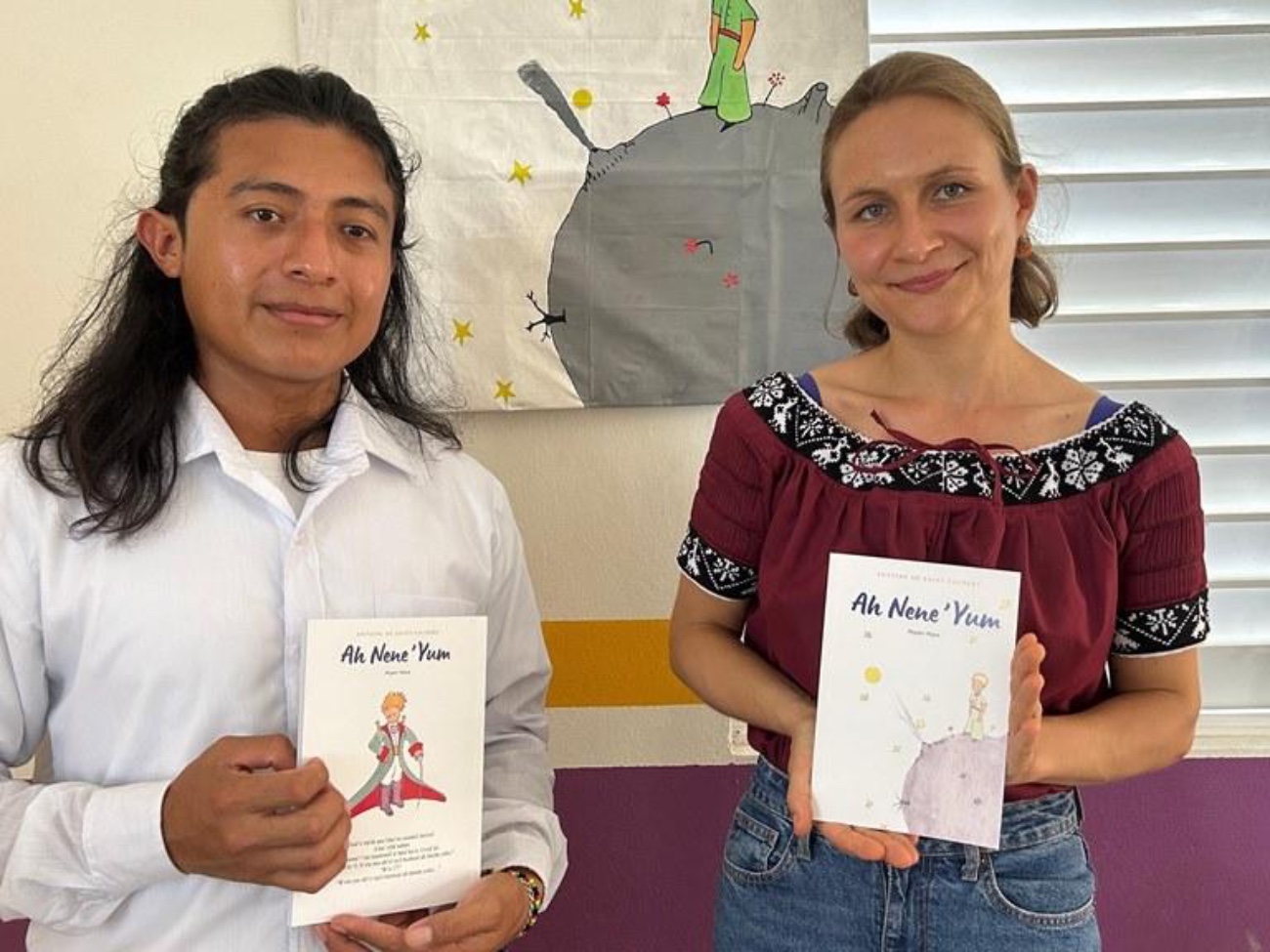
Hober’s close collaboration with Mopan language speakers and their desire for a written work in their language led to the translation of The Little Prince. Elvia Bo and Stanley Peck translated the book, with Nicole Hober providing linguistic guidance and support. “Since the Mopan language is primarily spoken and not written, many words lack standardized spellings. As a linguist, I was able to contribute to these decision-making processes,” the researcher explains.
For terms like airplane, which emerged after the precolonial Mayan era, loanwords were incorporated, such as ab ýon from the Spanish avión. The translators chose to describe words like rose – chäk k’i’ix top‘ (meaning “red, thorny flower”) – as roses are not a typical flower in Belize. Language contact is thus demonstrated without compromising the autonomy of the Mopan language.
© Juan Caal
Long-Lasting Research
About 1,000 copies were printed, accompanied by a freely available audiobook narrated by elementary school children and teachers in Belize. For many of these children, this is the first book in their indigenous language, since they were previously only taught in English at school. Nicole Hober’s idea for the book selection came from Professor Thomas Stolz from the University of Bremen, whose research involved translations of The Little Prince. The book’s global familiarity makes it an ideal reference point for a collaborative discussion of translation, language contact, and a unified written language.
In the meantime, Nicole Hober has submitted her dissertation. She aims to continue working with the Mopan Maya after completing her doctoral degree. Her work demonstrates that language contact does not necessarily signify a loss, but can be an expression of living multilingualism and a collaborative negotiation.
Further Information
Those interested can obtain a copy of The Little Prince in Mopan Maya in exchange for a donation by contacting Nicole Hober hober@uni-bremen.de. The donations will be used to support further language development initiatives, particularly the printing of bilingual children’s books written by Mopan speakers.