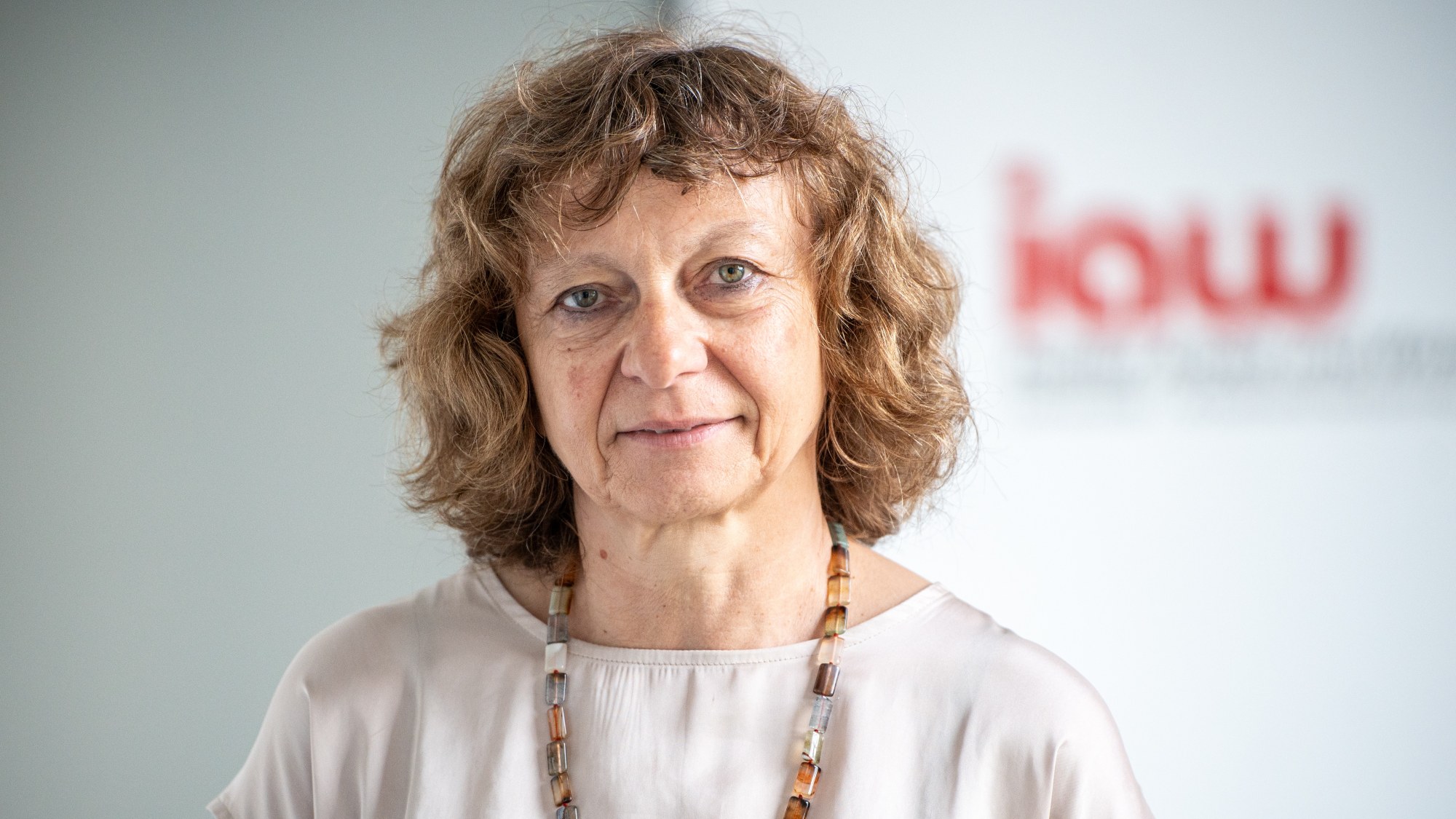
© Annemarie Popp / Universität Bremen
“Scientific Rigor Is Very Important to Me”
A conversation with Professor Irene Dingeldey about her time as director of the Institute for Labour and Economy
Labor market researcher Irene Dingeldey led the Institute for Labour and Economy (iaw) for five years. Her term as director officially ends in October; after that she will devote more time to research projects again. up2date. spoke with her about the iaw, her time as its director, and her plans for the future.
Professor Dingeldey, you have worked at the Institute for Labour and Economy since 2009, and spent more than ten years in the institute’s leadership. What does the iaw mean to you?
Starting my job at the iaw was the fulfillment of my dream of having a permanent academic position at an institute with a wide range of interesting topics. The iaw is an institute for social and economic sciences that is jointly supervised by the university and the Bremen Chamber of Labour. Its mission is to improve the living and working conditions of employees and to investigate changes in the work environment. In addition to academic analysis, practical relevance is integral to our work, which means bringing awareness to problems and showing potential solutions. That is what characterizes the iaw and has been an important motivation for me all these years.
What are your research topics?
Much of my research involves comparing welfare states and labor market policies in different countries. For example, my habilitation was a comparison between Hartz IV reforms and the social policies of Denmark and Great Britain. There is a much stronger obligation to work in Denmark, even for single parents. At the same time, however, they also have reliable childcare that makes this possible.
Another topic I have devoted a lot of time to are unions. In Germany, workers’ ties to trade unions are much weaker than in other countries, and have been declining for years. This has weakened the unions, reduced the number of collective wage agreements, and resulted in the emergence of a comparatively large low-wage sector.
I am also fundamentally interested in the international aspect, in a comparative assessment of the work environment of other countries relative to that in Germany. I want to investigate the areas that are better and how we can learn from these. Countries with higher collective wage agreements and/or higher minimum wages than Germany have significantly smaller low-wage sectors. It is also important to look at what aspects are better here. For example, a university degree in Germany is almost always free of charge, aside from semester fees. Most other countries have prohibitively high tuition fees, which often present a barrier to accessing higher education.
Were you able to conduct research during your time as director? This responsibility likely adds a multitude of additional tasks.
Yes, you bring up a very important point. Unfortunately, I was not able to do nearly as much research as director as I would have liked. That was one reason why I did not seek an additional term.
Do you already have a specific project planned?
I don’t have any definite plans, but I would like to focus on the topic of financing the welfare state, highlighting the “tax the rich” approach to this. An international comparison is important to me here as well to determine how financing is regulated in other countries. At the same time, I am also interested in the positions of political leaders in Germany regarding inheritance taxes and wealth taxes.
Looking back at your time as director of the iaw – what was your motivation for seeking office?
I completed my habilitation in 2020 and had been the director of our department as well as vice director for quite a while. My predecessor, Günter Warsewa, suggested I be asked if I would like to take on this role. I sought this position since it gave me the chance to help shape the direction of the institute.
What was your vision for the iaw and how much of this were you able to implement?
Scientific rigor is very important to me, meaning that iaw employees use innovative and evidence-based scientific methods and publish in academic journals. My goal was to promote early-career researchers and increase the number of employees who obtain a doctoral degree, and I was able to achieve this. Another of my initiatives was to bring the publishing of scientific journals to our institute. In addition to the Journal of Political Sociology, which Martin Seeliger oversees, we began publishing the “Vierteljahreshefte zur Arbeits- und Wirtschaftsforschung” (Quarterly Issues on Labor and Economic Research) in 2024 as the successor of the “Vierteljahrshefte zur Wirtschaftsforschung” (Quarterly Issues on Economic Research) that were discontinued in 2023.
What was the biggest challenge in the past five years?
Without a doubt, the pandemic. It began shortly after I became director, and disrupted every familiar structure. Everyone was at home and communication was relegated to the digital realm. Direct contact was lacking. We reacted by introducing digital services, holding classes online, and using digital tools for training new employees.
How is the situation now?
In some ways, the pandemic era continues to affect us. Many meetings and conferences have retained their digital form. This has a positive aspect, since it saves time and eliminates the need for travel. However, it is very important to meet regularly in person in order to retain interpersonal connection. Luckily, the iaw had a chance to make a clean break of sorts with the pandemic, which has improved personal relationships.
What was this break?
Our anniversary celebration in mid-September 2022, which actually took place a year late. We really wanted to celebrate in person and postponed the event to make that possible. It was a complete success and in retrospect, one of the most important events during my time as director.
What will be the first thing you do when your time as director has concluded?
In October, Dr. Timur Ergen from the Max Planck Institute for Social Research in Cologne has joined the iaw as its new director; however, Dr. Martin Seeliger has been serving as the interim director since April. I have already been able to use the last few months to focus more on research and am currently writing a paper with René Böhme about the myth of the unemployed who are “unwilling to work.” I have also begun working on a research proposal pertaining to the financing of the welfare state I mentioned earlier.
What do you wish for the future of the iaw?
I hope the iaw continues to fulfill its mandate of conducting research for the benefit of employees in Bremen and beyond. I hope that this includes regularly taking on new and relevant topics, thereby starting and continuing important socio-political discussion. It is important to me that this includes using scientifically substantiated facts to effectively counter the oversimplified, reductionist tactics often taken by populists when addressing complex issues. In order to fulfill these tasks, I hope that the recognition and financial support provided by iaw’s sponsors will be sustained and possibly increased going forward.
Profile
Irene Dingeldey was born in 1963 in Bensheim. From 1982 to 1989, she studied political science and German in Heidelberg and Madrid. She then went to Bielefeld University as a doctoral researcher, completing her doctorate there in 1996. After working in Weingarten and Gelsenkirchen, Irene Dingeldey moved to Bremen in 2000. She initially worked as a postdoctoral researcher at the Center for Social Policy Research, and then became head of the department at the Institute for Labour and Economy in 2009. From 2014 to 2019, she was vice director at the iaw and took over the office of director in 2020 for a five-year term. In 2025, she chose not to seek an additional term. Her appointment as director officially ends in October, but she will continue to conduct research at the institute until retirement (at or before the end of 2029).
Institute for Labour and Economy (iaw)
The iaw was founded in November 2001 by a cooperation agreement between the Bremen Chamber of Labour and the University of Bremen and has been under joint supervision ever since. The iaw currently has around 30 employees. It is comprised of three departments whose research focuses on the transformation of the working society, prospects for sustainable employability, and on regional development and fiscal policy. The iaw’s work encompasses a wide range of foundational research, applied research, and knowledge transfer. Their tasks also include scientific advisory services, such as regional studies, expert opinions, and evaluations. Research results are published in books and scientific journals. Important results also are summarized in three-page policy briefs, which are crucial for transferring knowledge to society. Workshops and other events with non-academic partners also play a vital role in the institute’s work.