
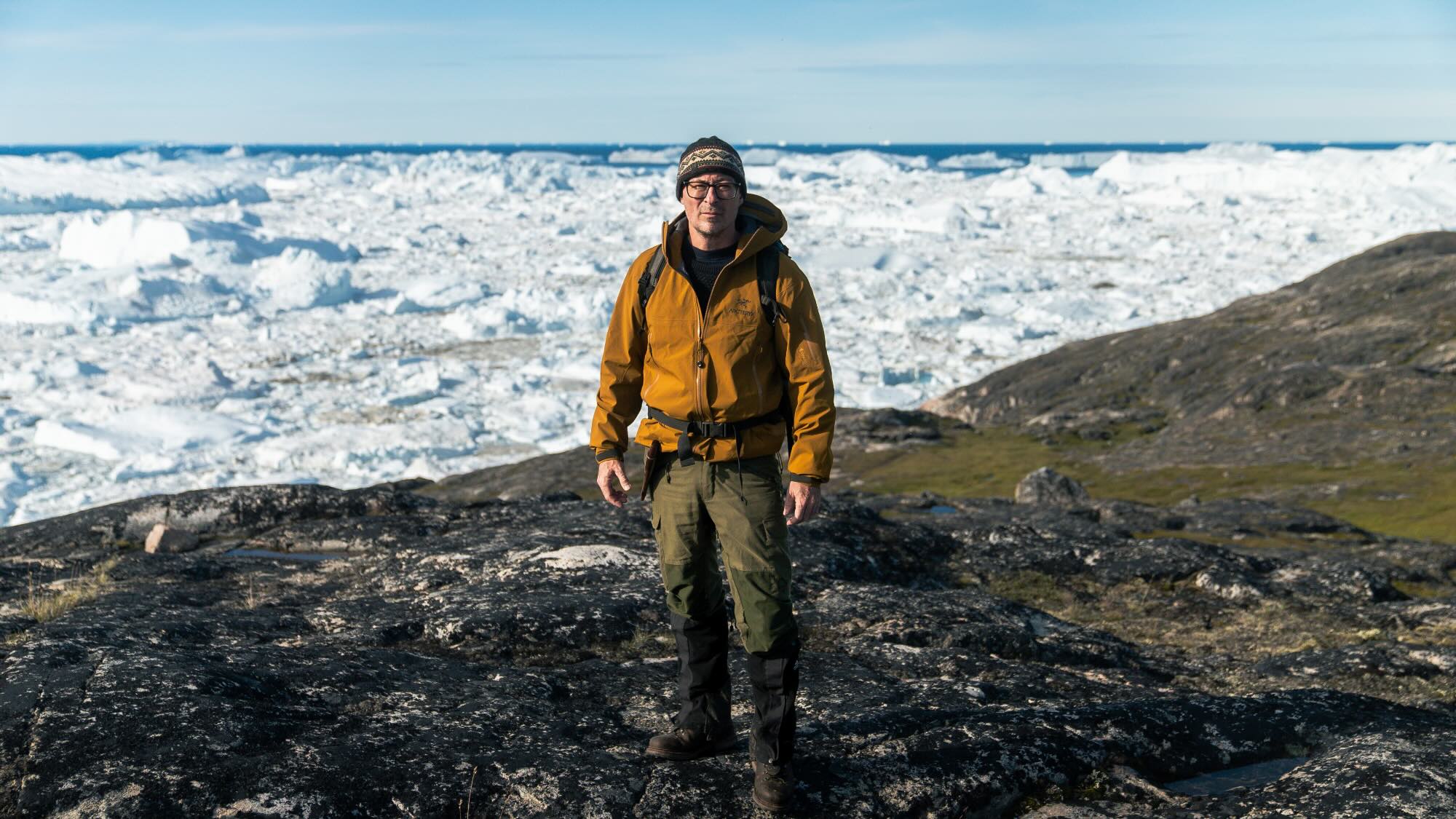
© Handful of Film
Ancient DNA as a Time Machine
Professor Eske Willerslev is investigating what old sediment samples from the ocean floor can reveal about the future of the seas
To learn about the future of our planet, Professor Eske Willerslev looks far back into the past. The Danish evolutionary biologist is considered a pioneer in the discovery and study of environmental DNA that is millions of years old. As holder of a U Bremen Excellence Chair, he can now use a newly developed method for the first time to examine marine sediment samples. The findings could provide answers to the question of how the world’s oceans will change under the influence of climate change.
Moments of inspiration can strike at completely unexpected times. Eske Willerslev knows this very well. When he returned from an expedition in Siberia as a young man, he felt empty inside. Looking out the window, he saw a dog relieving itself in the street. Suddenly, questions began running through his mind: What actually happens to the genetic material that this dog leaves behind in its feces? Could it be that ancient DNA is found not only in bones or fossils, but also in soil, dirt, or ice? That beneath our feet there are vast amounts of remnants and traces of animals and plants that lived hundreds, thousands, or even millions of years ago? Although his idea was initially met with ridicule, he remained undeterred – and proved to be right. Even during his studies, he extracted what is known as environmental DNA from ice cores. That flash of insight became the starting point of an extraordinary scientific career. At age 33, he became Denmark’s youngest professor at the time. In 2022, he published the sequencing of two-million-year-old genetic material from the permafrost of northern Greenland, setting a world record for the oldest DNA ever found. Using ancient genetic material, he has dispelled long-standing myths – for example, showing that mammoths were not driven to extinction by humans, but by climate change; that humans in the Bronze Age were more mobile than previously assumed; and that Vikings were by no means all as blond and blue-eyed as nationalist ideologies have often claimed.
From Permafrost to the Ocean Floor
Today, Willerslev is the leader of the Centre of Excellence for Ancient Environmental Genomics (CAEG and director of the Ancient Environmental Genomics Initiative for Sustainability (AEGIS), both at the Section for GeoGenetics at the University of Copenhagen’s Globe Institute. Furthermore, he holds a professorship at the University of Cambridge’s Department of Genetics.
His career path is vividly portrayed in the Emmy Award–winning documentary “Hunt for the Oldest DNA.” Together with the University of Bremen, Willerslev is turning his attention to the ocean depths. He is one of the U Bremen Excellence Chair holders who serve as bridges between the University of Bremen and leading universities around the world. Within the Cluster of Excellence “The Ocean Floor,” Willerslev and his team have, over the past seven years, developed a method to sequence ancient DNA from seabed sediments. Until now, it has primarily been fossils in sediment cores that provided insight into individual past plants and animals in the ocean. In the future, however, this picture could become far more detailed and include bacteria and microbes as well. These organisms do not leave fossils, but traces of their DNA remain preserved in the sediment.
How did the oceans change during periods of global warming? Which animal and plant species became extinct, and which emerged? How did species influence one another? These questions are not only important for understanding Earth’s history – they could also provide crucial clues about how future global warming will affect the world. “Future ecosystems will change dramatically due to climate change,” says Willerslev. “Looking at past warm periods gives us an idea of what to expect.” The evolutionary biologist compares this to analyzing stock market trends: “There, too, you look at how individual assets developed in the past under the influence of certain events.” Of course, the future can only be predicted to a limited extent by looking at the past. “But it is the most promising method we have.”
Detective Work in the Mud
The greatest challenge, Willerslev explains, is not finding ancient DNA in the ocean, but filtering out the relevant insights from a vast array of very different genetic information. This is significantly more complex than on land, because – unlike frozen sediments – ocean environments are also influenced by currents and temperature differences. In the mud, remains from the present and the past are mixed together. As a result, research on sediment samples resembles true detective work. Is it really ancient DNA, or does it belong to a bacterium still living in that sediment? And if it is ancient genetic material: which animal or plant did it come from? Was it once a natural part of marine flora and fauna, or a species washed into the ocean from a river? These are questions that can now be answered with the help of large databases and extensive programming: “We are now able to sort and analyze this vast amount of DNA information,” Willerslev sums up as the central result of the first project phase. In a second phase, the goal is to use this method to better understand what marine ecosystems looked like before the Ice Age – and to draw conclusions for the future.
“There is tremendous expertise in marine geology here, with outstanding researchers and excellent infrastructure.” Eske Willerslev
A Suitable Research Environment at MARUM
At MARUM, the Center for Marine Environmental Sciences at the University of Bremen, Eske Willerslev has found an ideal research environment that combines his expertise in ancient DNA with knowledge of marine sediments and microfossils. “There is tremendous expertise in marine geology here, with outstanding researchers and excellent infrastructure,” he says enthusiastically. The University of Bremen is equally pleased about the collaboration: “He brings a globally unique wealth of experience. Working with him is extremely enriching,” says Professor Michal Kucera, Vice President for Research and Transfer and project leader of the Cluster of Excellence “The Ocean Floor.” Kucera is a geologist and an expert in microfossils and the evolution of the oceans as part of Earth’s history. In addition to progress in the research project, he also welcomes the synergies resulting from the collaboration with Willerslev. For example, the University of Bremen has become part of AEGIS, a major research project led by Willerslev that aims to reconstruct past vegetation using sediment samples. The project seeks to decode how ecosystems and crops responded to environmental changes in the past, with the goal of using this knowledge to develop climate-resilient crops. The University of Bremen contributes a system for analyzing and curating sediment cores and, in return, receives €2.5 million in funding from the Novo Nordisk Foundation as a project partner. This success, Kucera says, is a direct result of the collaboration with Willerslev, whom he credits with having a sense for bold, far-reaching ideas. “He pursues big visions without dwelling too long on concerns. And he is incredibly good at inspiring others with his ideas, because he is genuinely enthusiastic about them himself.”