© Leona Hofmann / Universität Bremen
Earth Day 2026: “We Must Develop Alternatives”
Vice President Michal Kucera on driving societal transformation together
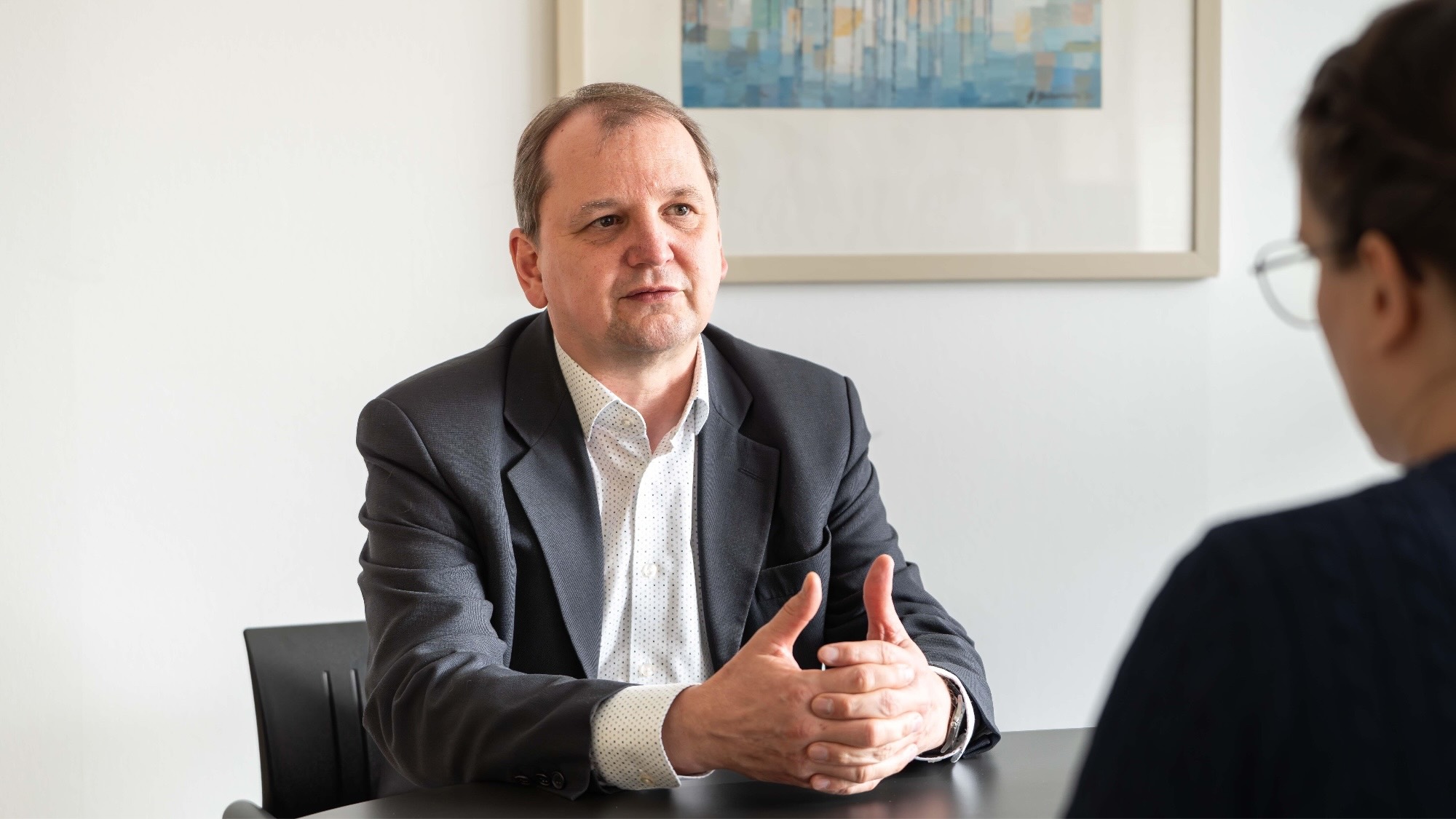
What responsibilities do universities have in the face of global challenges like climate change and resource scarcity? And how can collaboration lead to new solutions? In this interview, Michal Kucera, Vice President for Research and Transfer at the University of Bremen, explains why scientific expertise alone is not enough, why interdisciplinary cooperation is crucial, and how the Northwest Alliance can help transfer knowledge effectively into society.
April 22 marks Earth Day. How would you describe the role universities play in finding practical solutions to global challenges?
Universities exist to equip young people with knowledge and skills needed to address future challenges. At the same time, they conduct research that provides a foundation for understanding these issues: Which options are available? Which solutions are feasible, and which are not?
Universities can provide an in-depth analysis of the current state of affairs. However, it is not their role to implement solutions directly. That requires political and societal action.
This year’s Earth Day slogan is: “Get involved, take action, live sustainably – together for a future worth living.” What does this slogan say about the challenges of our time? This slogan underscores that the future of our planet is not solely a matter of natural sciences. It is a challenge that involves all disciplines.
It is not just about developing technical solutions based on natural sciences; it is also about bringing people together and enabling changes in our daily actions. This is a critical but complex topic – that is why it belongs at the university. And it is a topic of global significance.
The University of Bremen and the University of Oldenburg have joined forces to form the Northwest Alliance. Why is this collaboration especially important right now, and what can the alliance achieve that individual universities cannot?
Because this is such a comprehensive topic, the more we work on it together, the greater the impact. Within a network, diverse perspectives can be integrated, and the resulting messages can be developed more effectively.
Above all, the alliance provides interdisciplinary breadth. We need natural sciences, engineering, as well as humanities and social sciences working together. By uniting two universities, we offer a much broader range of expertise.
This is evident in our joint Cluster of Excellence “The Ocean Floor”. Bremen contributes expertise on the geological system, while Oldenburg provides expertise on biological aspects and biodiversity research. Together, we create a holistic and comprehensive picture.
The more we work on it together, the greater the impact. Prof. Dr. Michal Kucera
How can universities contribute to society, particularly in regard to climate change and sustainability?
Many of the ways to mitigate the effects of climate change involve people’s daily lives. Energy management is a prime example. On one hand, technical solutions are essential. On the other, we must address the pathways to the energy transition. Even if new energy sources become available, we will still need a way to transition to these from our current systems. Ultimately, we must answer very tangible questions, such as how we will heat our homes in the future. We have seen that such debates can quickly become emotional.
Here, universities play a vital role. With their factual expertise and commitment to neutrality, they can facilitate discussions, contribute knowledge, and support community engagement. Simply identifying problems is not enough. The key is to develop actionable solutions and involve people in the process.
In this context, Earth Day on April 22 serves as a reminder of how urgent these issues are. Similarly, Earth Overshoot Day, which marks the date by which humanity has used all the resources Earth can regenerate in a year, keeps moving earlier each year. It reminds us, year after year, just how quickly we are depleting our planet’s available resources. At this pace, our society cannot survive in the long term. We are living at the expense of others and future generations. That is why we must urgently develop alternatives.
How is the Northwest Alliance laying the groundwork for such solutions to emerge?
The alliance is still in its early stages, especially in regards to funding. If successful in the Excellence Strategy, we plan to invest in transdisciplinary structures. This would create more opportunities for projects that bring science and society together, foster dialogue, and support the professional development of our researchers. Larger networks enable these structures to be built more efficiently, leveraging economies of scale.
Which role do non-university research institutions and regional partners play?
A critical one. Bremen already has a strong track record of collaboration, particularly in the field of research data. We intend to contribute this strength to the alliance and expand it further. In addition to our existing partners, we will involve other institutions to implement transdisciplinary projects together.
Assuming the universities of Bremen and Oldenburg are successful as a University Excellence Consortium, where will we stand in seven years?
I see great potential in understanding the interplay of systems, particularly the interaction between the ocean and marine life in the context of CO2 absorption.
At the same time, I expect progress in developing concrete solutions, such as those in the “Martian Mindset” cluster, which addresses resource scarcity. Finally, we will contribute to societal transformation processes, such as those in the areas of the energy transition and social cohesion –topics that are closely interconnected.