© Matej Meza
Plants and Poetry
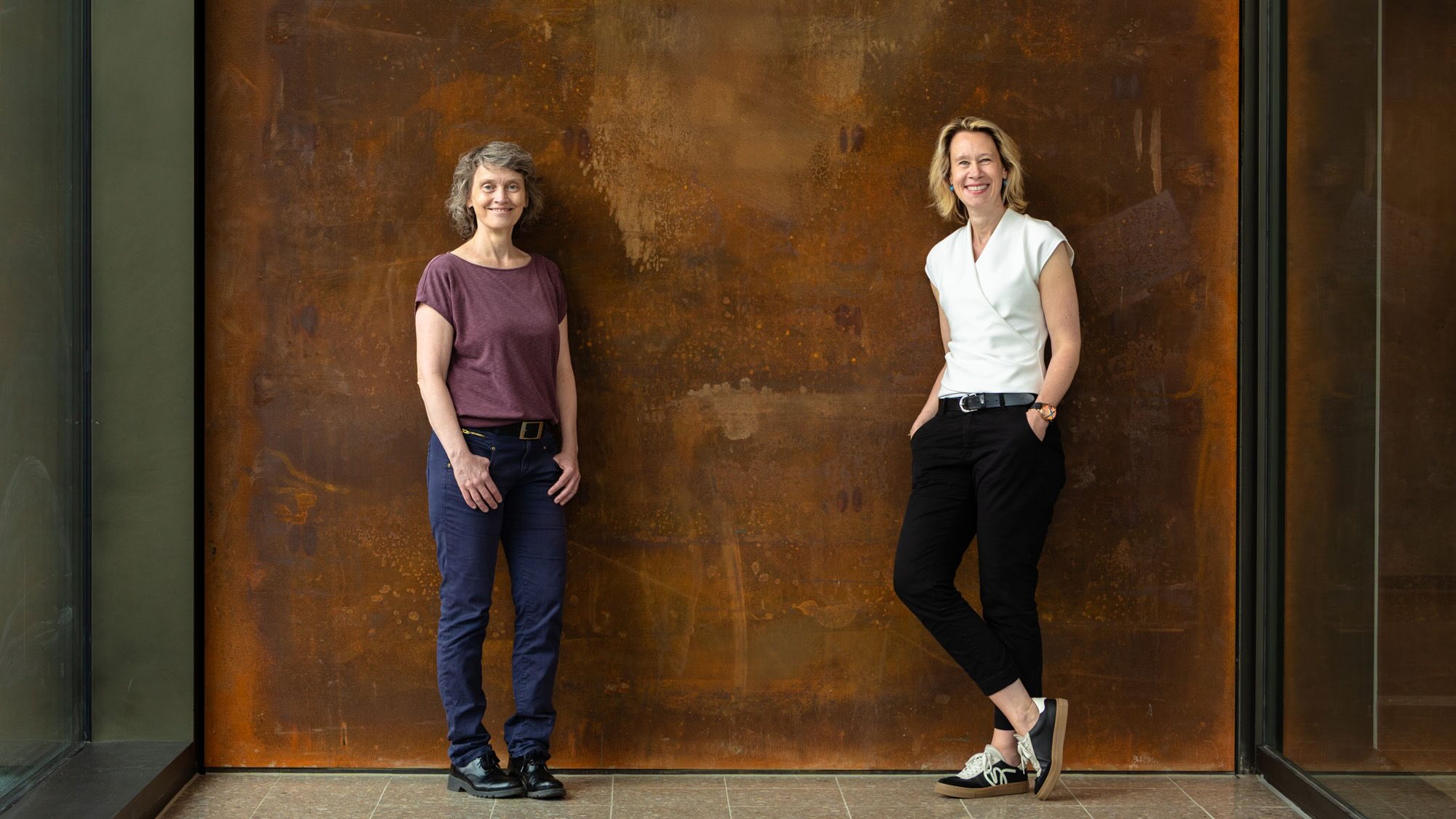
Professors Rita Groß-Hardt and Karen Struve on connecting science and society
Karen Struve and Rita Groß-Hardt’s fields of research could hardly be more different, and yet they share a commitment to connecting research with society. We asked both researchers how this became such a central part of their work.
Rita Groß-Hardt: Our Findings Need to Find Their Way to the Fields
“As a foundational researcher, I initially focused solely on gaining new insights – just for the sake of science. Applications were not really a priority. This changed when we made a discovery with great potential far beyond the lab. Our research on plant reproduction showed that plants can have three parents – a mother and two fathers. This revelation opened entirely new possibilities in plant breeding.
At first, we wanted to further develop our results in collaboration with a company – first and foremost because academic institutions lack the infrastructure for large-scale crop trials. Our goal was not to start a business, but to partner with one. Yet over time it became clear that if we wanted to see our results be implemented in agriculture in a “science to soil” manner, it would require us learning to think and act like entrepreneurs. That was a major step. Foundational researchers often shy away from business development or market applications, and we also lacked the expertise to navigate this path professionally. That is where the EU’s EIC Transition Program came into play. The EIC guides researchers and accompanies them in this process – with coaching on business models, technology development, and communication strategies. These measures profoundly changed how we see and approach our work.
“Technology transfer takes time, often requires courage, and can be accompanied by uncertainty. But it is also an opportunity.” Rita Groß-Hardt
We took this path as a team – and it quickly became clear that Saurabh Joshi, with his entrepreneurial instinct and leadership skills, was the right person to lead this process.
When it comes to technology transfer activities, I think it’s crucial to be clear about one’s motives. Is this about visibility? Social impact? Third-party funding? Commercialization? All are valid – but knowing what your motivation is and communicating it openly helps maintain inner strength and authenticity.
For my team and me, it is incredibly encouraging to see the real-world relevance of our research, such as when a large-scale grower sends us a photo of a field in Italy where sugar beets were grown using three parents as part of a pilot project.”
Karen Struve: The Value Lies in Resonance
“As a researcher, I have always identified with the ideal of connecting science and society. From the very beginning, I wanted to explain my work, and especially its relevance, in a way that anyone, even a stranger on the street, could understand.
To put this into practice, it helps not to see public engagement as an add-on, but to integrate it into teaching and research. Then it becomes enriching, not draining. When I teach a seminar on The Ocean in French Literature and organize with students a reading aboard a boat on the Weser River, the two complement each other perfectly.
In literary studies and language sciences, there is still a perceptible hesitation when it comes to public engagement and knowledge transfer activities. This is due, in part, to the fact that the German term ‘Transfer’ – both in academic and non-academic contexts – is still associated with technical innovations, start-ups, and patents. Hardly anyone thinks of panel discussions, readings, or cultural collaborations. Which is a shame! Because these are exactly the settings where meaningful public dialogue takes place – a valuable exchange (transfer) between research and society; an interaction that goes both ways. This is why I am convinced that exhibits, internet projects, and school outreach collaborations are equally valuable forms of knowledge transfer.
“Public engagement doesn’t just require commitment – it also needs institutional recognition. I am very fortunate to research and teach at a university that takes this seriously.” Karen Struve
However, it’s important to acknowledge that public engagement is still not a recognized currency in academic careers. For (early-career) researchers, publications and third-party funding remain the benchmarks. I understand colleagues who do not prioritize these activities. When a doctoral researcher must choose between writing a paper and organizing a film series, the paper will naturally take precedence.
For me personally, the value lies in resonance. I view ‘Transfer’ as a space where I can co-create something with people from very different backgrounds, beyond academia and the university. These encounters are immediate, inspiring, and challenging. I want to share the powerful literature and media that shape our thinking at the university, but also listen to what people in Bremen think about these texts and films. I want to hear their questions and reflections. This reciprocal exchange enrichens my research, and I see it as an absolute privilege.”
University of Bremen’s Transfer Magazine
This article first appeared in the 2025 Transfer Magazine by UniTransfer – the University of Bremen’s service point for knowledge and technology transfer. The magazine highlights individuals, projects, and collaborations that demonstrate the global social impact of Bremen’s research, extending well beyond our region.
Download the Transfer Magazine (in German) as a PDF [6,6 MB]